Still think NPR is a cute little public radio station? Think again.
The same technology that brought Google Maps to so many websites – the Application Programming Interface (API) – is now enabling NPR to become a distribution juggernaut. The news organization distribute the same content in many forms to many destinations with hardly any extra effort. This is the scale that publishers have longed for: create content once and see it published anywhere that can be imagined.
The NPR API delivered more than 1.1 billion stories last month and almost 5 million total in the past six months, according to a blog post today by NPR Director of Application Development Daniel Jacobson.”The big jump in total API requests from July to August are due to the launch of many new products in July,” Jacobson wrote. “Among them are the new NPR.org, the NPR.org Flash Player, the NPR News iPhone app, WBUR’s new web site, and Minnesota Public Radio’s new site.”
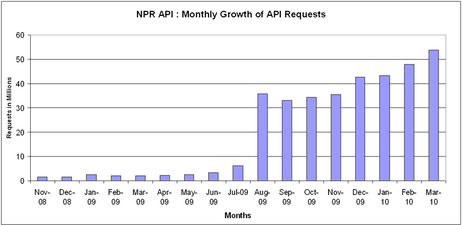
“While some media companies, such as News Corp, attempt to block their content from distribution, the NPR API seems to be making access to its content widespread,” Mike Melanson wrote on ReadWriteWeb.
Indeed, this strategy and execution is impressive. The combined reach through all the different channels that NPR content flows does nothing but build audience and brand loyalty, critical pieces of the NPR model.
Jacobson also posted an amazing slideshow (embedded below) that illustrates the life cycle, distribution and some key metrics for an NPR story. This is the way all new publishers should be producing their content and organizing their workflow.
 Mark Briggs
  Posted in




Like!! Really appreciate you sharing this blog post.Really thank you! Keep writing.
I learn something new and challenging on blogs I stumbleupon everyday.
Thanks so much for the blog post.
I simply want to mention I am just all new to blogging and site-building and seriously enjoyed your web-site. Probably I’m going to bookmark your site . You amazingly have terrific articles and reviews. Cheers for revealing your web page.
I like this website very much, Its a very nice office to read and incur information.
I have discovered some significant things through your blog post. One other subject I would like to talk about is that there are various games in the marketplace designed mainly for toddler age small children. They include pattern identification, colors, dogs, and models. These commonly focus on familiarization instead of memorization. This keeps children and kids occupied without having the experience like they are studying. Thanks
Isn’t it entertaining if we always talk about topics like that.:—-
I’m not sure why but this web site is loading very slow for me. Is anyone else having this problem or is it a issue on my end? I’ll check back later on and see if the problem still exists.
Do you believe reincarnation? Do you think past lives regression is real?
I wanted to thank you for this excellent read!! I definitely enjoyed every little bit of it. I have got you book-marked to look at new things you post…
Oh my goodness! Impressive article dude! Thank you so much, However I am experiencing problems with your RSS. I don’t know why I am unable to join it. Is there anybody else having similar RSS problems? Anybody who knows the answer can you kindly respond? Thanx!
I have observed that in the world nowadays, video games are definitely the latest fad with kids of all ages. Often times it may be not possible to drag young kids away from the activities. If you want the best of both worlds, there are lots of educational games for kids. Good post.
Your site is very helpful. Many thanks for sharing!
Hi, I do think this is a great website. I stumbledupon it 😉 I may return yet again since i have bookmarked it. Money and freedom is the greatest way to change, may you be rich and continue to guide others.
Aw, this was an exceptionally good post. Spending some time and actual effort to create a really good article… but what can I say… I put things off a lot and don’t seem to get anything done.
That is a really good tip especially to those new to the blogosphere. Short but very accurate info… Many thanks for sharing this one. A must read post!
After I initially commented I appear to have clicked on the -Notify me when new comments are added- checkbox and now each time a comment is added I recieve 4 emails with the same comment. Is there a way you can remove me from that service? Many thanks.
Next time I read a blog, I hope that it does not fail me just as much as this particular one. I mean, I know it was my choice to read through, but I really thought you’d have something interesting to say. All I hear is a bunch of whining about something that you could possibly fix if you weren’t too busy searching for attention.
Sapid Agency is a Search Engine Optimization company in New York City that provides SEO Services. Their proprietary SEO strategies help struggling websites and aspiring business owners to rank their websites higher in multiple search engines like Google , Yahoo and Bing. They provide local and gmb map ranking for businesses in NYC and many other local areas. Find more at https://www.sapidagency.com/ @ 145 E 57TH NEW YORK, NY 10022, USA, +1 971 341 5608 USA
Faytech North America is a touch screen Manufacturer of both monitors and pcs. They specialize in the design, development, manufacturing and marketing of Capacitive touch screen, Resistive touch screen, Industrial touch screen, IP65 touch screen, touchscreen monitors and integrated touchscreen PCs. Contact them at http://www.faytech.us, 121 Varick Street, New York, NY 10013, +1 646 205 3214.
hw28s1ys