September 2009


Future is now30 Sep 2009 08:56 am

One of the most frequent questions I’m asked when speaking to college journalists or young professionals is about jobs. How do I get one? Do they exist? What kind should I look for?

It’s natural to worry about how you will take your passion and training and turn it into a salary so you can afford such luxuries as food and heat. Those of my generation who entered the job market in 1991 know what you’re up against. That was a time of recession, as well, but we didn’t have the opportunities that digital media offer budding journalists today.

Consider the experience of Jon Glass who teaches and manages the Collaborative Media Room at Syracuse University. Glass is the former online editor of the Palm Beach Post so he knows how the professional news game works. Last year’s grads did quite well in landing interesting journalism jobs, despite the recession and significant downturn at most news companies.

“The common thread is that they entered college on a traditional journalism path but shifted gears late in college enough to land a full-time position where they jobs are in media companies,” Glass told me via email, where he also provided the following overview:

Lauren Bertolini (@MsLaurenRae) graduated with a newspaper degree in May 2009 and took a calculated risk by accepting an unpaid internship as a social media coordinator for NBC Local, which helps run the Web sites in major markets such as New York, Chicago and Miami (ex. http://www.nbcnewyork.com). This was a new position so she became the voice of their social media efforts on Twitter, Facebook, Digg and more. By summer’s end Lauren was offered a job for at least the next year as NBC Local’s social media editor.

Christine Petrozzo (@capetroz ) was a standout magazine major when she graduated in 2008. She took an internship with NBCOlympics.com before the 2008 Summer Olympics and stayed with the NBC family later that fall when she moved to IVillage.com where she’s an associate Web producer.

Sunnivie Brydum (@sunnivie) thought she’d be writing for a magazine until her final semester this year when she crash-coursed herself on Twitter, blogging and multimedia reporting. Sunnivie had interned at Out Front Colorado and started blogging for them again before leaving Syracuse. Soon after graduation in May, she was hired as full-time Web editor given editorial control of http://www.outfrontcolorado.com.

Dipti Khatri-Kapadia graduated with a broadcast journalism degree in 2008. Dipti tried to land a full-time reporting job at a local TV station in the Northeast but eventually her marriage took her to London. Passionate about doing multimedia work, this past summer Dipti landed the first-ever digital producer job for WSJ.com Europe based in London.

Jon Davenport (@JonDavenport1) already knew the media industry was rapidly changing so spent his year in the Magazine-Newspaper-Online master’s program learning anything he could from multimedia reporting to Flash to site and code development. The investment paid off in that he landed a job late this summer as Online Editor for the Glens Falls Post-Star — http://www.post-star.com — where he’s using all those skills.

Congratulations to all these young professionals. And thanks, Jon, for sharing their stories.

You can follow Jon Glass on Twitter at @jonvibe and if you’re in San Francisco at the Online News Association conference this week, he’ll be happy to tell you more about these success stories and others. Also at the conference, don’t miss the Career Summit where you can meet prospective employers who are looking for talent to fill their openings.

If you know of other journalism job-finding success stories, post them in the comments or drop me a line.

Execution is everything and Future is now24 Sep 2009 10:14 am

It’s classic workplace culture: employees shake their heads and curse the inaction of management (whether under their breath of with colleagues around the water cooler). In times of stability, it’s a drain on innovation. In times of disruption, it’s dangerous (and quite possibly fatal.)

I visited the newsroom of the Wichita Eagle yesterday and gave one presentation on social networking and mobile and one on managing news as a conversation. I started the day, however, with a call to action, drawing on the wisdom of Stanford’s innovation guru Tina Seelig. Her tips for fostering creativity and innovative thinking include:

  • Don’t frame the problem too tightly
  • Know how to fail fast and frequently
  • Never miss a chance to be fabulous
  • Don’t wait to be anointed

stobiasThat last point struck a chord in Wichita. Like most newsrooms, there is a mix of people out front in terms of experimentation, some still resisting change and a whole bunch in the middle who want to move forward but aren’t quite sure where to start.

rsylvesterIf you follow the use of Twitter by journalists, you’re probably aware of Ron Sylvester’s innovative work. He’s one of the first newspaper reporters to consistently use Twitter in the courtroom. Also in Wichita is a reporter named Suzanne Tobias who covers family life issues and started using Twitter as a networking tool around the same time Sylvester started using it to cover court proceedings.

Both reporters started using Twitter around the same time without really asking an editor or manager for permission. Their assumption was simple: if this works, if it makes me a better reporter, then it won’t be a problem. If it doesn’t work out, I’ll just stop doing it.

As a safety net, Tobias created a “Twitter Tips” file and used it to stash away story ideas received via Twitter connections. This was going to be her defense if a supervisor challenged her on the usefulness of this new (and often misunderstood) phenomenon.

The file grew large. But it was never needed.

“One of the items in that “Twitter Tips” file mentions a story headlined ‘Error on state test slips past everyone — except student,’” Tobias told me via email. “That story — gleaned from a random tip from someone I follow on Twitter (a local teacher) — ended up setting an all-time record for page views on Kansas.com. Links to the story from the Yahoo home page and Fark sent
nearly 4 MILLION people to our web site that day. And all from a lowly Twitter tip. :)

While the story of how Tobias and Sylvester effectively used Twitter is instructive to journalists everywhere, the story of how to take initiative – and not wait to be anointed – is an even more powerful story for anyone working their way through these turbulent times (whether in journalism or not).

You’re not still waiting to be anointed, are you?

Random23 Sep 2009 04:09 am

Heather Armstrong, known to her 1.2 million followers on Twitter as Dooce, has an idea on how to turn hate mail into cash:

“Internet, let me introduce you to Monetizing The Hate. Here I will be posting all the hate mail I get in my inbox and all the hateful anonymous and not-so-anonymous comments left on this website.”

I first spotted this story on Journalism.co.uk, which highlighted the experiment but didn’t ask the obvious question: could this work for news organizations? If there are two things most news organizations have in abundance it’s outspoken people who think the editors are too liberal or conservative (or just plain idiots) and a need to make money online.

Controversial topics in the news like Acorn, the health care debate and the march on Washington have ramped up the amount of hate mail coming to news organizations recently. I talked with one newspaper editor last week who reported receiving death threats (over the paper’s lack of perceived coverage of Acorn) serious enough to warrant a phone call to local police.

dooceDooce, the popular blog written by Armostrong, seems an unlikely place for such vitriol. But after reading Armstrong’s post about “Monetising The Hate,” it reminded me that if you’re popular enough, you’ll be a target for someone. In true Dooce style, Armstrong is excited about the possibility of her new venture:

And let me tell you, it is a hoot! And the money? OH THE MONEY! I am going to roll around naked in all that money!

We probably won’t to see any ad directors at local newspapers pitching the idea this way. But if Dooce can make it work, news organizations would be wise to try to take all that hate they currently allow to in the comments of their stories and turn it into cash. What have they got to lose?

It's worth noting21 Sep 2009 06:04 am

While catching up on my RSS feeds over the weekend, I found several pieces that were interesting enough to share. So here’s a quick roundup of some highlights from last week in the world of journalism and technology…

The next book18 Sep 2009 07:58 am

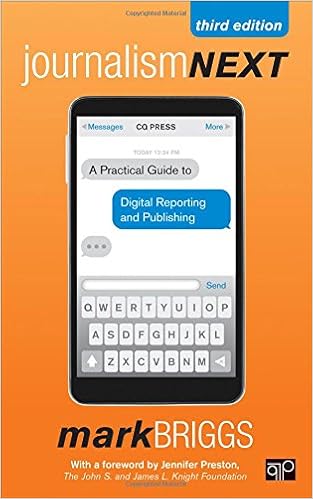
Due to the success of Journalism 2.0 as a downloadable PDF, I’m often asked whether the next one, Journalism Next, will be available as an e-book. I’m happy to report that, yes, it will be available digitally and even as an a la carte option.

CQPress is publishing Journalism Next and informed me recently that it will offer it as an e-book/online subscription, offering users the ability to customize books, building a custom publication a chapter at a time from the entire CQPress library of content. Pretty cool, huh?

The e-book version of Journalism Next should be available about the same time as the print edition, which is scheduled to be released on Nov. 10. You can pre-order the book at CQPress’s web site for $21.95.

Readers in Europe will be able to order the book from Sage Publishing, which is the parent company of CQPress, by using this link: http://www.uk.sagepub.com/cqpress.sp. It should also be available on Amazon.co.uk. It’s unclear whether there will be any lag time between the time when the book will be available in the U.S. and available on Amazon.co.uk.

Execution is everything and Future is now16 Sep 2009 09:04 am

News21 is an ambitious project, attempting to chart a course of innovation for news coverage that is both “immersive” and “socially powerful,” in the words of Jody Brannon, News21’s national director. Brannon, who has been working in online news since 1995 with stints at washingtonpost.com, USAToday.com and MSN.com, has been leading the project for the past couple years. I checked in with her last week to see how it’s going and to get a better understanding of the project and its mission.

news21The bottom line: impressive. If you’re a fan of innovation for news, News21 should be on your radar. Co-funded by Knight and Carnegie, the project brings together 12 universities to experiment with new forms of investigative reporting and multimedia storytelling. One of the goals, according to Brannon, is to “unleash young journalists who want to tell stories in new ways — many of which are noticeably different than the way journalism was produced last century, and by that I mean the 1990s. Many of this year’s projects are very non-linear. Some have little text. And some I struggle to find, in my mind, a polished nut graph of sorts. But it is incredibly rich and often evocative. It’s very blended media, using styles of documentary, MTV, the Learning Channel and even The New Yorker.”


Continue Reading »

Entrepreneurial journalism and Future is now14 Sep 2009 09:26 am

Like a lot of people, Ben Ilfeld and Geoff Samek were frustrated with the quality and quantity of local news available in their town. And, like more and more entrepreneurial journalists, the duo decided to turn frustration into opportunity by launching a new local news site to fill that perceived gap.

But this is no Wordpress blog dressed up to look like a news site. While that is certainly a great way to get started, Ilfeld (an economics and political science major in college) and Samek (a computer science major) had a much bigger vision from the start. Now they are managing a 14-person operation in Sacramento and looking for ways to export the model to other communities who might have similar frustrations with local news in their town.

sacpressSacramento Press features a completely customized technology platform, original reporting by full-time staff and innovative job titles like “journalism support manager” (who works with correspondents and user-submissions). As we are seeing in Dallas, Ann Arbor and Portland, the hyperlocal news operation can move from dream to reality with the right execution.

Sacramento is home to one of the nation’s largest – and most troubled – news publishing companies. McClatchy (my former employer) has its corporate HQ there and publishes the Sacramento Bee and SacBee.com. The 800-pound gorilla in town probably views the Sacramento Press as a harmless fly swirling around a dinner plate. But this is an interesting startup with visions of changing the local news business far beyond its Sac-town boundaries.

I spoke with Ilfeld last week to learn more about Sacramento Press. Here is what he had to say:


Continue Reading »

Execution is everything11 Sep 2009 09:07 am

I’m in Cooperstown today, speaking at the New York Newspaper Publishers Association annual conference. As a left coaster, I’m a bit overwhelmed by the history here: the local newspaper has been around for 201 years, the hotel is celebrating its 100th birthday and this is the 156th edition of the conference. (And tomorrow I’ll be taking in the baseball hall of fame.)

Before speaking about social networking and mobile for news publishers, I’m sitting in some morning sessions, including one called “The Deadly Sins of Newspapers.” Ed Efchak, who spent decades at the Bergen County Record and has done stints at Belden and INMA, offered this list of “sins:”

  • not owning your localspace
  • not concentrating on customer winners
  • becoming brand-less
  • losing focus
  • being boring
  • not being digital first
  • not being different

While not as compelling as Bill Wyman’s recent treatise on 5 key reasons newspapers are failing, he’s hit on some interesting points and is concluding with an impressive slideshow of innovative print designs from around the world. If I can get a link to the preso online, I’ll post it here.

UPDATE:

Slides are apparently not available online, but Efchak did offer these step of absolution:

Absolution

  • get rid of fixed ideas and paradigms
  • visualize the ideal situation
  • go get the facts
  • reduce waste
  • think of ways to make it possible
  • get input and ideas from many people
  • take responsibility – have courage

Entrepreneurial journalism and Future is now09 Sep 2009 10:18 am

Do you have a great idea for an innovative product or business? Are you a media entrepreneur? Come pitch your idea at ONA to a panel of seasoned Silicon Valley venture capitalists and media entrepreneurs for the chance to meet with a product developer and a VC.

Susan Mernit and I are helping to coordinate a session at the upcoming Online News Association conference in San Francisco called “6 in 60.” It’s scheduled for Friday, Oct. 2.

It is a chance for 6 of the best and brightest to pitch their idea to our ONA panel: Christine Herron, VC at First Round Capital, Mary Hodder, serial entrepreneur, David Cohn, media entrepreneur and founder of Spot.us — and the ONA audience.

Each presenter will have 5 minutes to pitch, 5 minutes for comments from a panel of judges and then the judges pick a winner, who will receive individual consultations with a product developer and a Venture Capitalist to help move their idea along.

To share your idea, contact me at mark@journalism20.com.

Help us spread the word: Please share this with your network on Twitter, Facebook, blogs or email.

It's worth noting05 Sep 2009 09:38 am

Recently I was asked to compile a list of journalism organizations that recent college grads or early career professionals should know about. There are plenty of options so no matter your interest or focus, there is likely one that’s right for you. Some are more about the business of journalism than the craft, but that’s pretty important these days, too.

Searching around, I was unable to find a definitive list, so I thought I’d post the one I submitted here. Let me know if I’m missing any.

[Added 9/8/09 from suggestions in comments]

Note: these are all U.S.-based organizations that are at least big enough to cover more than one state.

Next Page »