September 2008


Future is now25 Sep 2008 06:08 am

newstrain

What’s it like to run training sessions at a newspaper that has been through layoffs and buyouts and is currently on the block?

I found out this week at the Union-Tribune in San Diego leading three sessions for an APME NewsTrain workshop. Great people, intriguing ideas and interesting conversations. But the economic crisis infecting the news industry was an inescapable subtext.

One moment stood out: a full elevator can’t help but listen as one Union-Tribune employee greets another and then says “I’m leaving - taking the buyout.” The reply comes: “I’m so sad because I thought we were becoming friends” as she departs one floor below the rest of the workshop attendees.

Alright - who’s ready to talk about ethics in the digital age?

After a collective deep breath, we carried on. Because what else can we do?

Ryan Pitts led off the workshop with a 55 mph drive-by of interesting web technologies and concepts. I call it the shiny new object list. Ryan was nice enough to share that list and you can find it here.

My sessions were more about discussion and less about demonstration (presentation slides here). Here are some links with the points I tried to make with each:

Continue Reading »

Future is now22 Sep 2008 07:05 am

I’m traveling to San Diego tonight to participate in an APME Newstrain workshop where several dozen journalists will gather to brush up their skills and hopefully learn something new. (It was originally scheduled for last year, but postponed due to the California wildfires.)

My first session is “Covering Communities in New, Cost-effective Ways.” This is more marketable than reinventing journalism, but not much different in my view.

Reinvention is too big for most editors and publishers. And it sounds expensive at a time when expense budgets have been squeezed dry.

So we’ll talk about social networking, user generated content, etc. But the elephant in the room will be how much different today’s local news operation needs to be.

It won’t happen overnight. But a little change, a little progress every day can move the needle. Baby steps.

As MGM Mirage Inc. Chief Executive Terry Lanni told the APME conference attendees recently, quoting U.S. Army chief of staff Gen. Eric Shinseki:

“If you don’t like change, you’re going to like irrelevance even less.”

The next book18 Sep 2008 09:03 am

Follow-up to my last post …

At the ONA conference, several people asked me if the new book would be called “Journalism 3.0″?

I’m not sure.

I think it depends on whether people think the work being done today that I will highlight in the book is substantially new and better than the work highlighted in the first version.

I know we’ve already gone farther than Journalism 2.1. But a full 3.0 upgrade?

Say what you will about Microsoft’s all-too-frequent software updates, but imagine for a moment having such a system for journalism. One morning you log on and automatically receive knowledge and a platform for microblogging. The next morning it’s comment moderation.

But, alas, journalism is not software. It’s people. So instead of “bugs” we have “habits.”

Is it time to download a new version yet?

The next book17 Sep 2008 06:52 am

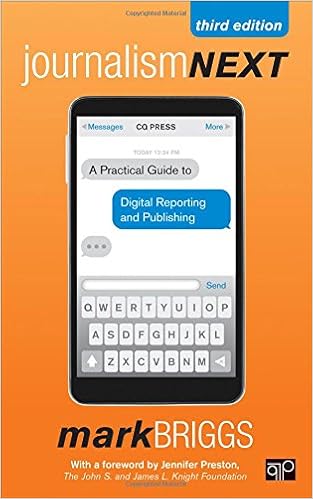
While I was in DC for the ONA Conference last week, I met with an acquisitions editor to discuss a new version of Journalism 2.0 for the college textbook market. The next step is to submit a chapter outline for the updated version.

Here’s a list of topics I drafted this morning. Please let me know by email or comment if you have any thoughts about what I’m missing or what I should leave out.

NEW REPORTING METHODS
Crowdsourcing
Advanced Blogging
Microblogging
Mobilzing audience (attracting UGC)
News as a conversation (dealing with UGC)
Mobile tools and delivery

MULTIMEDIA
New photo editing fundamentals
New video editing fundamentals
Slideshow fundamentals
Audio gathering and uses
Databases and maps

EDITING AND DECISION MAKING
Understanding your web audience
Introduction to web analytics
Writing web optimized headlines

Execution is everything16 Sep 2008 06:38 am

For my money, the best session at last week’s ONA conference had to be “Mobilize your Audience!” Poynter’s Ellyn Angelotti led NowPublic’s Len Brody through an insightful analysis of the startup’s “crowd powered media” site based in Vancouver, B.C.

Brody said lots of mainstream news organizations “think” they are doing this, but “it’s a façade.” Why? Because it’s a lot of work.

“Creating a dialogue and engaging them is very hard work,” Brody, who added that for NowPublic’s editors and news staff, the biggest part of the day is working with community; they slap hands, pat backs, and point people in right direction.

Angelotti referred to them as “community weavers.”

NowPublic raised $12.5 million a year ago and has seen traffic grow five-fold since. Brody broke down the different types user generators by their motivation and dispelled the myth that people want to get paid for their citizen reporting.

The top categories for user generators on NowPublic, which has 130,000 of them around the world:

1. Those motivated by money (smallest)
2. Those motivated by ego
3. Those motivated by issues
4. Accidental bystanders who didn’t set out to do any reporting (largest)
5. And the “plain old crazy” users that every web site seems to have

Brody said he doesn’t consider NowPublic’s content “journalism” as he deflected questions about verifying the accuracy of the content. He said if someone posts something questionable, the community will “smoke it out pretty fast.”

It's worth noting15 Sep 2008 06:59 am

Reflecting on the ONA 08 conference on the long plane ride back to Seattle, I realized that my pre-conference concerns about whether this conference would be be able to generate its usual positive energy were thankfully dispelled.

The group of 750 journalists, technologiests, educators, students and independent media innovators filled the ballrooms of the Capitol Hilton with excitement and constant talk of “what could happen” instead of “what is not happening.”

One common theme I noticed was how corporate technology can’t keep pace with innovative start-ups of pureplays. Everyone I talked to seemed unhappy with at least part of their technology platform, and this includes people from MSNBC.com, ESPN.com and washingtonpost.com. But no one seemed to be allowing this to slow them down.

And I was quite impressed with The Associated Press efforts in the mobile space.

And the talk of journalism educators to get their students up to speed on technology. And marketing. And business models. And entreprenership.

Just because there aren’t many traditional job openings doesn’t mean there isn’t any opportunity.

Uncategorized11 Sep 2008 10:33 am

Blogging a conference is so passe. And besides, Twitter is so much easier. If I’m quiet for a while, assume nothing interesting is happening. Or the newtowrking reception has started.

Follow along: twitter.com/markbriggs

It's worth noting09 Sep 2008 10:25 pm

I’m traveling tomorrow to Washington, D.C. for the ONA 2008 Conference.

In years past, this conference has been insulated from the funereal atmosphere at other conferences I attend that specifically target newspapers. Talk of layoffs, buyouts and new digital demands didn’t surface at ONA. The halls pulsed with optimism and exceitement.

It will be interesting to see if that same level of positive energy is present this week. I hope so.

I can’t help but recall the first few years of ONA, when the optimism of us news geeks was tempered by the head-in-the-sand approach many of our employers were taking in the relatively new age of the digital revolution. Complaints of “they just don’t get it” were all too common.

Now the pendulum has swung fully.

The future of many mainstream news companies rests on the shoulders of those who attend this conference. And the need for innovation has never been greater.

It’s good to see conference planners are aware of the topic that needs top billing: The business of news.

This confab has grown from a plucky little gathering to one of the most important confabs for the media business each year. Naturally I’m looking forward to it and will be posting updates on the blog and Twitter. Stay tuned.

Execution is everything07 Sep 2008 07:26 am

In my last post, I urged newspaper staffs to pick up the pace. Since I’d like this blog to offer ideas at least as often as it points out problems (hopefully more often), here’s one thing every newspaper can do today to move forward and make some progress during these challenging times (at least on the editorial side).

Run the entire newsroom like the sports department.

OK, I’m biased since I started my journalism career in sports and fully subscribed to Frank Deford’s idea that even the best sports journalist would be seen as the world’s tallest midget. But those shorts-wearing, junk-food-eating dudes in the corner can teach the rest of the newsroom how to get maximum productivity - and maximum impact - out of their work.

Write something every day.

If something happens on your beat - no matter what day or time - personally cover it.

Blow it out. Preseason special sections and postseason tournament coverage almost kills them. But they continue to do them because readers love them. And they still put out the regular section.

Run photos with almost every story.

Blog like crazy.

It’s a long-running joke in sports departments that “every night is election night,” a not-so-veiled reference to the special recognition bestowed on the news side a couple times a year when reporters work off-hours and the editors order pizza to recognize the extra effort.

What if every day were “election day” in the newsroom? (Without the pizza, of course.)

Execution is everything and Future is now06 Sep 2008 07:13 am

Lost Remote calls it “the same sad song, different sad verse.” I call it “the new normal.”

Staffing levels fluctuate at businesses all the time. Those who work in the newspaper industry and avoided this operational reality for so long should be thankful for their good fortune. But this is how the world works.

I hear newspaper execs often wish to “find the bottom” or wait “until the dust settles.” Sorry. Not gonna happen.

Grab the ball and run with it. There’s no time to wait for more teammates to help out.

I’m not saying this is better. Or fun. It just is. And the sooner everyone still working for a news organization figures this out and picks up the pace, the better off they’ll be.

A bunker mentality won’t get you out of this.

Next Page »