June 2009


The next book30 Jun 2009 02:06 pm

Do you have a crystal ball? If so, can I borrow it?

Today is my deadline to submit the next version of Journalism 2.0 to my editor and publisher. The good news: I’m actually finished with the manuscript, all 80,000 words. The bad news: it will be at least four months until it’s available in print.

Whatever happens to journalism, technology and social media in those four months will not be included in the book. (That’s the paradox of writing a book about digital publishing; it appears hypocritical, but it’s the preferred medium of the target audience.) So I get to sweat through a summer of discontent, discovering new methods and innovations that would have been great additions to the book but will be left out.

As I submit the final draft, I can’t help but wonder what up-and-coming technology or method will “blow up” in the second half of the year and influence journalism the most? Tumblr? Google’s Wave? Internet TV?

My first book, for example, was published in 2007 (and recently passed 100,000 downloads) and didn’t include a single reference to Twitter. (Oops.) Now that I have almost an entire chapter on Twitter (and microblogging), will it still be relevant as 2009 comes to a close?

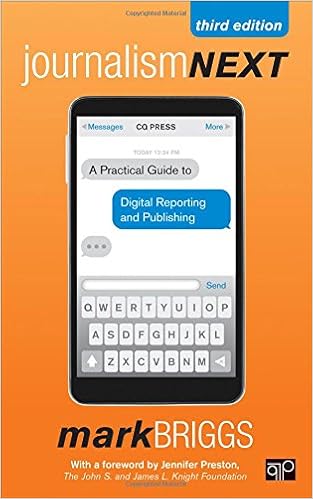
Here’s a tentative list of chapters for the book, tentatively titled Journalism Next and due out in mid-November. It looks a little different than my first attempt last September, but is surprisingly quite similar:

UNIT ONE: MULTIPLE PLATFORMS
Chapter 1: We are all Web workers now
Chapter 2: Blogging: Beyond the basics
Chapter 3: Crowd-powered collaboration
Chapter 4: Microblogging: Write small, think big
Chapter 5: Going mobile

UNIT TWO: MULTIMEDIA
Chapter 6: Visual storytelling with photographs
Chapter 7: Making audio journalism ‘visible’
Chapter 8: Telling stories with video

UNIT THREE: EDITING AND DECISION MAKING
Chapter 9: Data-driven journalism and digitizing your life
Chapter 10: Managing news as a conversation
Chapter 11: Building an audience online

I plan to continue posting excerpts from the book here. Feedback is still welcome, if not for the book, then at least for other readers of this blog. I’d like to thank everyone who has contributed so far,  through comments on the blog, emails, answering questions or just conversation. The book is really just a collection of wisdom from all of you and many others. So if I missed the “next big thing,” it’s actually just your fault. ;)

Entrepreneurial journalism and Execution is everything26 Jun 2009 11:25 am

Here is Lunn’s scorecard, which he calls “Six Milestones from 30 Seconds to 3 Years,” for what an insanely great web product looks like to the average user:

30 seconds: “I get it.”
3 minutes: “I’ve used it and still get it, and it has not annoyed me yet.”
3 days: “I find this really useful or fun.”
3 weeks: “I am raving about this to other people.”
3 months: “I couldn’t imagine not having this, and I’m boring my friends telling them about it.”
3 years: “How weird to see this on Oprah.”

    Read the entire post for his elaboration on each point. And the next time you’re invited to a strategy or planning meeting, use the scorecard as a checklist for the goals of your mission. After all, if your service is not useful and people are not raving about it to others, is it worth spending 40-60 hours a week working on? (Appearance on Oprah optional.)

    The next book24 Jun 2009 09:36 am

    (NOTE: This series of posts is an excerpt from my upcoming book, Journalism Next, which will be published by CQPress and is due out in the fall.)

    How many breaking news updates did you send last week? How many video stories did you publish last month? By percentage, how much did your online audience grow (or shrink) last year?

    These questions, and dozens more, can be easily answered by sophisticated news operations and solo bloggers alike. Productivity, of course, is one of the key measurements for managers. But going beyond the basics, tracking content published is a smart business strategy.

    “This kind of data helps us decide how best to apply the newsgathering resources we have,” says Ryan Pitts, assistant managing editor for digital media for the Spokesman-Review. “For example, we might love multimedia and be able to produce great video, but when we look at the audience numbers, it forces us to consider the return we’ll get on that investment of time. That doesn’t mean we abandon video as a storytelling tool; it means we pick our spots a bit more carefully. Looking into our analytics also helps surface stories that deserve following up, blogs that we can leave behind, projects that show promise and deserve to be expanded. It’s important to pay attention: We’re making decisions that directly affect the future of our newsroom, and we have access to far too much useful data to just go with our gut.”

    Baker’s dozen: Here is a starter list of content types journalists and newsrooms should be regularly tracking:

    1. Total news stories per day
    2. News stories by topic or section (sports, business, local, etc.)
    3. Total blog posts per day (if these are different than news stories on your site)
    4. Blog posts by specific blog
    5. Slideshows per week
    6. Video stories per week
    7. Podcasts or other audio stories
    8. News updates (if these are different than news stories on your site)
    9. Breaking news email alerts
    10. SMS or other mobile news alerts
    11. Email newsletters that are not sent automatically
    12. Twitter, Facebook or other social network posts
    13. User generated content (blog posts, photos, videos)

    The easiest way to track this information is with a Web-based spreadsheet that multiple people can access so the task of updating the information can be distributed. Across the top, list the content types you already publish on a fairly regular basis. Down the left site, list the dates. After a week’s worth or month’s worth of dates, insert a line that totals the amounts in each column for that week or month. Then copy and paste that week or month format for each time period going forward and now the spreadsheet will do the math for you.


    Continue Reading »

    The next book22 Jun 2009 07:24 am

    (NOTE: The following series of posts is an excerpt from my upcoming book, Journalism Next, which will be published by CQPress and is due out in the fall.)

    Can marketing and analytics save journalism? Not on their own, of course. But we live in a world where the amount of content produced has increased exponentially, yet we still each have just two eyes, two ears and one mouth. So journalism needs to find new benefits from new marketing strategies and measurement tactics.

    This type of marketing is not advertising, or slogans, or logos. And this type of measurement isn’t counting bylines for a performance review. Digital publishers need to establish effective publishing goals and be consistent in their pursuit of those goals. Quality content published in some significant quantity and engineered to be easily found in search engines is a recipe for a successful digital publishing business.

    “When a person conducts a search, you are competing against nine other results on that first result page,” Monica Wright wrote on the Search Engine Journal Web site. “Your title tag and description are your first impression to attract potential audience. You can capture new online readership by setting yourself apart with useful and engaging tags.

    “But above all – good writing still prevails. Quality, relevant, in-depth content will not only attract the bots, but will capture new audience as well.”

    In order to build your audience online, you need to analyze what you publish, what your readers like and don’t like, and then do more of what they like. You also need to make sure that your content, especially that which your current readers have shown interest in, can be found by new audiences through search and shared through social media tools.


    Continue Reading »

    It's worth noting17 Jun 2009 05:51 pm

    NPR has an interesting piece on a small ad agency in New York that has opened its doors to those in the profession who are looking for work. The job seekers get a place to research job opportunities and a place to network. The ad agency gets more sounding boards for new ideas and, occasionally, more new ideas from the job seekers.

    Seems like a model some newsrooms, with plenty of extra desk space these days, should entertain.

    Corporate HR departments would probably provide the wet blanket with some lame policy about non-employees using company equipment, but if not, it could be a cool coexistence with working journalists bouncing ideas off job-seeking journalists for stories they are reporting and vice versa.

    Several people have floated the idea of newsroom cafes as a way to open up newsrooms to conversation in the community. How about a shared workspace, which has worked for years with technology and other creative professionals? Job-seeking journalists wouldn’t be able to afford a monthly rent, so tap their expertise and get back some of the brain power lost in the last round of layoffs.

    It's worth noting13 Jun 2009 06:54 am

    Cleaning out the inbox on a Saturday morning and I ran across this …

    Skip Journalism School: 50 free open courses

    I’m a big proponent of education, so I don’t advocate skipping school to take some free online courses. (The title is just marketing anyway, right?) On that note, if you are in journalism school I highly recommend taking some business and computer science classes. Actually,  no matter what you’re majoring in, business and computer science should be part of your electives if you’d like to be relevant in your career.

    The Online College site behind the link also has other interesting offerings, such as 50 awesome Ivy League lectures all about the future and Tools for a tough market: 100 resources for college grads.

    So if you have nothing going on this weekend you can have yourself an online learning party. Enjoy.

    It's worth noting12 Jun 2009 09:10 am

    Earlier this week, a report of “man overboard” from a Seattle-based ferry put the local Coast Guard station into immediate action. As boats and helicopters were being launched, real-time updates were being posted to Twitter. By the Coast Guard.

    This full disintermediation, when the audience can get the news and information directly from the source, is only going to increase. For journalists, an official source using Twitter is a double-edge sword: the news organization doesn’t have to wait for press releases, but the information is not necessarily unbiased nor objective. Dale Steinke, who runs the web site for King 5 News, said his team was closely watching the Coast Guard’s Twitter stream (@uscgd13) but didn’t broadcast or publish anything directly from it. (And King 5, of course, was posting updates to its own Twitter feed: @king5seattle.)

    “Our newsroom treated Twitter like a scanner for purposes of our on-air and online coverage, following tweets from the U.S. Coast Guard (@uscgd13) and the Washington State DOT (@wsdot), which we verified independently before publishing,” Steinke told me via email. “We DM’d them for updates and we put callouts to our followers for anyone who was on the ferry. We also found a photo @JohnLivengood took on the ferry and we asked for permission to use it on air and online. In the meantime, we retweeted the link to it, http://yfrog.com/0kdnkj.”

    Brian Forth, a friend of mine who runs a Web site building company, was one of the people who were following the developing story on Twitter and blogged about it the next day.

    During the next 15 minutes, I learned that the Coast Guard had scrambled a helicopter from Port Angeles as well as a boat from Station Seattle to assist in the search. Eventually, the tweet “@All the Coast Guard is standing down from the search” was posted after learning the report came from someone that thought they saw someone in the water. Better safe than sorry, I guess.

    So, what’s the point? The point is that there is a lot that could’ve happened. The fact that users were connected meant the Coast Guard could’ve asked for help, and King 5 could determine if it was worth sending a crew to report, etc.

    The Coast Guard, it turns out, has an ambitious social media strategy which you can hear about in the video below. We often talk about the “people formerly known as the audience” (via Jay Rosen) who are now participating in reporting the news. Increasingly, journalists need to consider how to deal with  “people formerly known as sources,” too.

    Execution is everything10 Jun 2009 10:49 am

    scott poradScott Porad, the CTO of the company behind FailBlog.org and I Can Has Cheezburger?, highlights what hinders innovation at news organizations – and every other big company – in a recent blog post that actually made no mention of the news industry.

    Some people view the world with rose-colored glasses. Mine are journo-colored, I guess.

    So I immediately identified with Porad’s post, titled Corporate/Startup, and the contrast between working at corporate news organizations (which I did for 15 years) with working at a startup (which I’ve been doing for seven months now).

    The discussion centered on the difference between the type of person that chooses to work at corporate jobs vs. those that are drawn to startup companies. Porad concludes that the balance between time spent doing vs. planning is the most significant determining factor. And I completely agree.

    Over an 8 year period, my last startup grew from a startup into a corporate environment with several hundred employees and layers of management. For the last 5 or 6 years of that I felt like we spent 80% of our time planning and only 20% of our time doing stuff.

    To me, this very frustrating. I enjoy just doing stuff, and I felt like all my time was spent discussing/debating/arguing with others about what we should be doing, instead of just doing stuff to see what worked. A lot of the time it felt like we were just paralyzed in planning…literally gridlock.

    Frustrating, indeed. Anyone who works for a news organization (or other large corporation, for that matter) can weave tales of woe around all the planning, brainstorming, off-site retreats and other groupthinks that led nowhere. Isn’t it ironic that news companies, given a breaking news event, quickly break out of “paralysis by analysis” and move at breakneck speed to cover the news, print extra copies and provide bonus coverage on the air or online?

    So here’s today’s “breaking news:” your business is in trouble. Stop planning and start doing.


    Continue Reading »

    Entrepreneurial journalism04 Jun 2009 02:59 pm

    All problems are opportunities. The bigger the problem, the bigger the opportunity.

    That is the headline from a recent presentation by Tina Seelig at the Stanford Entrepreneurial Leadership Lecture Series. It comes from Vinod Khosla, one of the co-founders of Sun Microsystems who became a general partner of the famous VC firm Kleiner, Perkins, Caufield & Byers in 1986.

    “No one will pay you to solve a non-problem,” Khosla says in a video Seelig shows to her classes and this presentation.

    So what about newspapers and mainstream journalism? I’d say we have a big problem here. And I think there are a lot of people who would pay you to solve it – starting with the group that met in Chicago last week.

    Seelig should have been in that meeting in Chicago. She is the executive director of the Stanford Technology Ventures Program and her insights in creative thinking and the entrepreneurial mindset have led her to write several books (her latest is What I Wish I Knew When I Was 20) and teach numerous classroom successes of applied problem-solving.

    Her philosophy is to teach students to become comfortable with solving problems, so she starts with small problems and then gradually gives them bigger and bigger problems and, by the end of the course, the students are ready to tackle anything.

    She goes through several incredible exercises of how to spur creative thinking for entrepreneurial strategies. In one example she divided a class into teams, gave them $5 “seed money” and two hours to make as much money as possible. (One team made more than $200 pumping up bike tires – and didn’t even win.) Other classes were given paper clips and the outcomes are amazing.

    “We frame problems way too tightly,” Seelig says in the lecture.

    Really? The news industry sure has, continuing to frame its economic problems so tightly that conversations which started in the 1990s about charging for content and linking continue today.

    “If we keep unpacking them and unpacking them, we realize we have resources that are more valuable than we ever imagined,” she adds.

    In 2007, the exercises became part of a world-wide entrepreneurship week series where students were challenged to create as much value as possible in five days using a pack of Post-It Notes. The concept has become a tournament and the past couple years of results are linked here. To see what a team did with rubber bands, play the video.

    What do you think the group of newspaper publishers that met in Chicago last week would come up with, given a pack of Post It Notes or some rubber bands? (Or even $5?) How would news company executives fare at one of these tournaments?

    Seelig’s lessons are excellent, especially if you’re someone who jumped (or was “pushed” by layoffs) off the proverbial cliff. If every problem is an opportunity, the bigger the cliff, the bigger the chance to succeed.

    Seelig’s tips to become a successful entrepreneur:

    1. Make your own luck. (Also known as “the harder you work, the luckier you’ll be.”)
    2. Know how to fail fast and frequently
    3. Don’t wait to be anointed
    4. Never miss an opportunity to be fabulous

    So listen to the podcast. (Unfortunately there isn’t video, which is really too bad since she shows several videos in her presentation.) The examples cited and the concepts discussed are the perfect antidote for the doom-and-gloom attitude found in many journalists today.