Execution is everything


Execution is everything and Future is now05 Nov 2009 09:03 am

Now that (most) journalists are working in digital – using audio, video, social media, blogs and databases in their reporting – how do we define whether any of it is good or not?

It’s a tough question, and one that I’ve tackled a couple of times recently at workshops and conferences, most recently at the National College Media Conference. To help me find some answers last week in Austin, I enlisted the help of some smart people from differing backgrounds:

Gary Chapman, director of The 21st Century Project at the LBJ School of Public Affairs, the graduate school of public policy at the University of Texas at Austin.

Bryan Murley, director for innovation, Center for Innovation in College Media, and assistant professor, Eastern Illinois University.

James Wickett, general manager, Community Impact Newspapers, a growing hyperlocal publisher based in Austin.

The topic is so thick and we had such limited time that I was only able to ask the panelists and handful of questions:

1. Journalists have been told for years they need to “go digital.” Many have, but in a “ready, fire, aim” manner where getting going with digital was accomplished but quality was never assessed. How does anyone know whether what they’re producing in breaking news alerts, blogs, video and other forms is good journalism?

2. Should news organizations and journalists have a sense of urgency about defining what is good in digital journalism? If so, what advice do you have for establishing this urgency?

3. What is an example of good digital journalism you have seen recently (that you can hopefully talk about with some authority)? We’ll have a projector so we can show best examples if you bring links.

All three agreed that a sense of urgency was needed in defining what’s good in digital journalism, and Chapman said it best:

“Journalists need to discover their sense of mission. Otherwise it’s just going to be a bunch of cats flushing toilets.”

Chapman also said the “continuum of information isn’t going to change” even as the methods for sending and receiving communication change rapidly. He suggested that journalists are still not using analytics as effectively as they should be and recommended more effort be focused on them.

“It’s important to split the media from the medium,” adde Wickett, whose company is print-focused with a growing digital presence. “There’s still a place for print.”

Murley came the closest to attempting a rigid definition for quality, suggesting that technical merits on multimedia and additional components to a package (timelines, maps, etc.) can help steer us toward a standard definition and a goal to shoot for.

I closed with a few minutes on how to take a practical approach back to a newsroom for standards in defining what’s good. Here’s a link to the supporting “slides” for the preso, even though it may be difficult to use by itself.

It’s a conversation every newsroom and classroom ought to be engaged in these days. Getting going with digital was the first step, but maintaining and improving quality is an equally important second step.

Execution is everything20 Oct 2009 09:14 am

As you already know, news is no longer a one-way lecture. It’s conversation.

It started with comments on stories and blog posts and has evolved in the age of social networking with Facebook and Twitter. So what’s next? Going “offline” and actually meeting with readers and sources, face-to-face.

A small-but-growing number of reporters is finding power in emphasizing the “social” in social networking. Tweetups, meetups and other gatherings allow the people behind the news company’s brand to come out from behind the curtain, shake hands, press the flesh and have real conversations with real people.

What a concept.

“People were giddy, taking pictures of the presses running and everything. It was fun,” said Jude Seymour, a political reporter with the Watertown Daily Times in New York, in reference to an event the newspaper hosted recently. “We wanted people to know who we are. We didn’t want to be faceless. We are real human beings and we’re interacting with their lives.”

The Times has hosted a handful of events that only get promoted on Facebook and Twitter. So the turnout isn’t huge, but the interaction is valuable. Oh, and there is also a little be of marketing involved, but don’t tell anyone.

“We felt like we’ve got to reward people for doing this, for being part of our community,” Seymour said. “So we had a party and brought people to our operation. People really connected to it. One guy who’s become active won a 3-month subscription to the paper. The whole thing doesn’t cost much money and we’re able to hit them over the head with all we’re doing to cover the community.”

The Times hosted a “party,” to celebrate hitting the 100-fan mark on its Facebook page, at the newspaper that drew 30-35 people in May. The meetings at a local Panera Bread only draw about a dozen people, but still allows reporters and editors to “tear down a lot of the preconceptions” people have about the news organization, according to Seymour.


Continue Reading »

Execution is everything and Future is now24 Sep 2009 10:14 am

It’s classic workplace culture: employees shake their heads and curse the inaction of management (whether under their breath of with colleagues around the water cooler). In times of stability, it’s a drain on innovation. In times of disruption, it’s dangerous (and quite possibly fatal.)

I visited the newsroom of the Wichita Eagle yesterday and gave one presentation on social networking and mobile and one on managing news as a conversation. I started the day, however, with a call to action, drawing on the wisdom of Stanford’s innovation guru Tina Seelig. Her tips for fostering creativity and innovative thinking include:

  • Don’t frame the problem too tightly
  • Know how to fail fast and frequently
  • Never miss a chance to be fabulous
  • Don’t wait to be anointed

stobiasThat last point struck a chord in Wichita. Like most newsrooms, there is a mix of people out front in terms of experimentation, some still resisting change and a whole bunch in the middle who want to move forward but aren’t quite sure where to start.

rsylvesterIf you follow the use of Twitter by journalists, you’re probably aware of Ron Sylvester’s innovative work. He’s one of the first newspaper reporters to consistently use Twitter in the courtroom. Also in Wichita is a reporter named Suzanne Tobias who covers family life issues and started using Twitter as a networking tool around the same time Sylvester started using it to cover court proceedings.

Both reporters started using Twitter around the same time without really asking an editor or manager for permission. Their assumption was simple: if this works, if it makes me a better reporter, then it won’t be a problem. If it doesn’t work out, I’ll just stop doing it.

As a safety net, Tobias created a “Twitter Tips” file and used it to stash away story ideas received via Twitter connections. This was going to be her defense if a supervisor challenged her on the usefulness of this new (and often misunderstood) phenomenon.

The file grew large. But it was never needed.

“One of the items in that “Twitter Tips” file mentions a story headlined ‘Error on state test slips past everyone — except student,’” Tobias told me via email. “That story — gleaned from a random tip from someone I follow on Twitter (a local teacher) — ended up setting an all-time record for page views on Kansas.com. Links to the story from the Yahoo home page and Fark sent
nearly 4 MILLION people to our web site that day. And all from a lowly Twitter tip. :)

While the story of how Tobias and Sylvester effectively used Twitter is instructive to journalists everywhere, the story of how to take initiative – and not wait to be anointed – is an even more powerful story for anyone working their way through these turbulent times (whether in journalism or not).

You’re not still waiting to be anointed, are you?

Execution is everything and Future is now16 Sep 2009 09:04 am

News21 is an ambitious project, attempting to chart a course of innovation for news coverage that is both “immersive” and “socially powerful,” in the words of Jody Brannon, News21’s national director. Brannon, who has been working in online news since 1995 with stints at washingtonpost.com, USAToday.com and MSN.com, has been leading the project for the past couple years. I checked in with her last week to see how it’s going and to get a better understanding of the project and its mission.

news21The bottom line: impressive. If you’re a fan of innovation for news, News21 should be on your radar. Co-funded by Knight and Carnegie, the project brings together 12 universities to experiment with new forms of investigative reporting and multimedia storytelling. One of the goals, according to Brannon, is to “unleash young journalists who want to tell stories in new ways — many of which are noticeably different than the way journalism was produced last century, and by that I mean the 1990s. Many of this year’s projects are very non-linear. Some have little text. And some I struggle to find, in my mind, a polished nut graph of sorts. But it is incredibly rich and often evocative. It’s very blended media, using styles of documentary, MTV, the Learning Channel and even The New Yorker.”


Continue Reading »

Execution is everything11 Sep 2009 09:07 am

I’m in Cooperstown today, speaking at the New York Newspaper Publishers Association annual conference. As a left coaster, I’m a bit overwhelmed by the history here: the local newspaper has been around for 201 years, the hotel is celebrating its 100th birthday and this is the 156th edition of the conference. (And tomorrow I’ll be taking in the baseball hall of fame.)

Before speaking about social networking and mobile for news publishers, I’m sitting in some morning sessions, including one called “The Deadly Sins of Newspapers.” Ed Efchak, who spent decades at the Bergen County Record and has done stints at Belden and INMA, offered this list of “sins:”

  • not owning your localspace
  • not concentrating on customer winners
  • becoming brand-less
  • losing focus
  • being boring
  • not being digital first
  • not being different

While not as compelling as Bill Wyman’s recent treatise on 5 key reasons newspapers are failing, he’s hit on some interesting points and is concluding with an impressive slideshow of innovative print designs from around the world. If I can get a link to the preso online, I’ll post it here.

UPDATE:

Slides are apparently not available online, but Efchak did offer these step of absolution:

Absolution

  • get rid of fixed ideas and paradigms
  • visualize the ideal situation
  • go get the facts
  • reduce waste
  • think of ways to make it possible
  • get input and ideas from many people
  • take responsibility – have courage

Entrepreneurial journalism and Execution is everything26 Jun 2009 11:25 am

Here is Lunn’s scorecard, which he calls “Six Milestones from 30 Seconds to 3 Years,” for what an insanely great web product looks like to the average user:

30 seconds: “I get it.”
3 minutes: “I’ve used it and still get it, and it has not annoyed me yet.”
3 days: “I find this really useful or fun.”
3 weeks: “I am raving about this to other people.”
3 months: “I couldn’t imagine not having this, and I’m boring my friends telling them about it.”
3 years: “How weird to see this on Oprah.”

    Read the entire post for his elaboration on each point. And the next time you’re invited to a strategy or planning meeting, use the scorecard as a checklist for the goals of your mission. After all, if your service is not useful and people are not raving about it to others, is it worth spending 40-60 hours a week working on? (Appearance on Oprah optional.)

    Execution is everything10 Jun 2009 10:49 am

    scott poradScott Porad, the CTO of the company behind FailBlog.org and I Can Has Cheezburger?, highlights what hinders innovation at news organizations – and every other big company – in a recent blog post that actually made no mention of the news industry.

    Some people view the world with rose-colored glasses. Mine are journo-colored, I guess.

    So I immediately identified with Porad’s post, titled Corporate/Startup, and the contrast between working at corporate news organizations (which I did for 15 years) with working at a startup (which I’ve been doing for seven months now).

    The discussion centered on the difference between the type of person that chooses to work at corporate jobs vs. those that are drawn to startup companies. Porad concludes that the balance between time spent doing vs. planning is the most significant determining factor. And I completely agree.

    Over an 8 year period, my last startup grew from a startup into a corporate environment with several hundred employees and layers of management. For the last 5 or 6 years of that I felt like we spent 80% of our time planning and only 20% of our time doing stuff.

    To me, this very frustrating. I enjoy just doing stuff, and I felt like all my time was spent discussing/debating/arguing with others about what we should be doing, instead of just doing stuff to see what worked. A lot of the time it felt like we were just paralyzed in planning…literally gridlock.

    Frustrating, indeed. Anyone who works for a news organization (or other large corporation, for that matter) can weave tales of woe around all the planning, brainstorming, off-site retreats and other groupthinks that led nowhere. Isn’t it ironic that news companies, given a breaking news event, quickly break out of “paralysis by analysis” and move at breakneck speed to cover the news, print extra copies and provide bonus coverage on the air or online?

    So here’s today’s “breaking news:” your business is in trouble. Stop planning and start doing.


    Continue Reading »

    Execution is everything and The next book27 May 2009 09:19 am

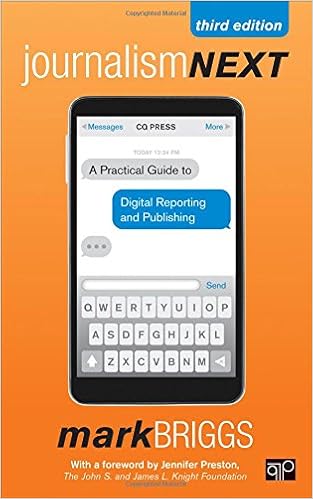
    (NOTE: The following is an excerpt from my upcoming book, Journalism Next, which will be published by CQPress and is due out in the fall.)

    Charles Betram was home mowing his lawn on a sunny weekend in Lexington a year ago when his assignment editor and good friend, Tom Woods, called. Woods was watching his nephew’s baseball team playing and suggested Bertram come to the park to see this remarkable kid playing on the other team.

    “I was a little put-off at having to go inside and get cleaned up on my day off, but I really love baseball,” said Bertram, whose son was drafted by the Detroit Tigers and is playing in their minor league system. “So I hustled to the park.”

    Adam Bender was 8 years old when Bertram showed up to his Southeastern Rookie League at Veterans Park. Having lost a leg to cancer when he was one, Adam was competing with only one leg. Bertram, a photographer at the Herald-Leader newspaper, arrived too late to shoot photographs of the game so he used the trip to meet Adam’s parents and coaches and find out when the next game would be played.

    Bertram came back for the next game and shot still photographs of Adam. While the images of a one-legged boy competing with able-bodied youngsters were compelling, they didn’t tell the whole story.

    “After looking at the shoot, it was fairly obvious that I needed video to show his incredible ability to ‘run’ the bases,” Beteram said.

    So Bertram returned with a video camera and captured the action of Adam hopping to first base after a hit. He receives arm braces at first base, then rounds the rest of the bases quickly. From his catcher position, Adam blocks the plate but lets an opponent score on one play. Then comes back on the next and records the out.

    Hopefully, you have already seen the two-and-a-half minute video. If not, you should. It has no voiceovers. It has no titles. No interviews. No description of the setting, no context for the story. The images, the action, the emotion are so compelling the viewer is moved with inspiration. It’s a powerful story of the human spirit that could be told best in video. No other form would do as much.

    “I realized after one game of shooting that the only difference between Adam and his teammates was that he had only one leg,” Bertram said. “His attitude was that of a baseball player — not a ‘handicapped’ baseball player. That’s when I decided to shoot the video with no voiceovers and no interviews. I wanted the video to stand strictly on his athletic ability and without any additional attention drawn to his assumed handicap.”

    Published on June 1, 2008, the video went viral. At the time, the most popular video on the Herald-Leader Web site would receive 500 views. Bertram’s video of Adam has now been seen nearly 3 million times, about half coming from the Herald-Leader site, the rest from embedded video players on YouTube and other sites, include Lance Armstrong’s Livestrong.org site.

    “I had several comments from photographers who appreciated my approach to telling Adam’s story,” Bertram said. “In fact, I heard that after the story ran in the paper, that several of his teammates were a little upset and wondered what was so special about Adam, that they were baseball players too. I think I was prouder of that comment than anything else relating to the entire story. I knew then that I had accomplished a story on the human spirit and not just a story on a kid with a handicap.”

    Since the story was published in the Lexington Herald-Leader, and on www.kentucky.com, Adam has been invited to throw out first pitches at home games for the Chicago White Sox, Cincinnati Reds, Houston Astros, and has been invited to a Garth Brooks benefit in Las Vegas. He was also profiled in a 10-minute story on ESPN and appeared on CBS, ABC and NBC and even in People magazine.

    It’s a great lesson for journalists: be faithful to the story, no matter the medium.

    Execution is everything28 Apr 2009 01:20 pm

    Steve Buttry posted the complete – and I mean complete – details of Gazette Communications’ plan to revolutionize its business yesterday. It’s worth a glance if you care about the evolution of local news and worth a full read if you’re responsible for running a local news business. (Sorry, but suing Google is not part of the plan.)

    In the interest of full disclosure, Gazette is a partner of Serra Media, the company I co-founded last year, so I’m not an objective bystander. I’m very much cheering for them. That said, there are several things that make this plan worth taking a look at, but the most striking to me is the ambition. (Mark Potts has a good overview and analysis of the tactical points.)

    In an era of layoffs and budget-cutting, the temptation to go into “bunker mode” and try to ride out the storm is strong. But it could also be fatal. The ability to make quick decisions and move on many fronts is what will allow those local media companies to make the transformation into the digital age. The others will be left behind.

    The Gazette has the audacity to believe it can launch new projects at the same time it overhauls its model away from one-day consumption. They don’t have time to worry about the culture; they’re too busy creating a new one on the fly.

    It’s ambitious – and risky. Both are elements in the equation of most successful start-up businesses, which is exactly how the Gazette is operating. (Given the uncertainty for most local news companies today, more should follow suit.)

    I’ve spent the past few months presenting the idea of Newsgarden as a product/service that can be licensed by news companies. I’m impressed by the organizations who act quickly; the Gazette is one of a handful that have made a decision the same day as the demo.

    It speaks to their ability to be productive in testing new ideas during these uncertain times.

    It shows they are committed to moving forward.

    I heard one entrepreneur say recently that success in business comes down to productivity. Whomever can conceive, test and launch the most ideas wins because it’s very difficult to come up with the perfect product on your first try.

    So even if other news organizations don’t take a page (or five) from the Gazette plan, I hope they take a sense of the ambition and apply it to their own operation.

    Execution is everything07 Apr 2009 09:10 am

    How easy can digital video be? It is estimated that 13 hours of footage is uploaded to YouTube every minute.

    The low cost and ease of use mean anyone can participate. The quality varies greatly, of course. Both in journalism and in the greater video ecosystem.

    This debate about quality has strangled many news organizations. Unwilling to publish what they see as an inferior product, editors and photographers painstakingly edit and produce high-level work that, while great, simply takes too much time and effort. Then, when the pageviews are modest (at best), journalists start blaming video as a format and retreat to what they know best. (When was the last time an editor suggested dropping the education beat because the latest story only saw a couple hundred hits?)

    Meanwhile, the quick and less polished video content on news sites often draws bigger audiences. This discovery has led several news organizations to start broadcasting video with cell phones from the scenes of news events. They should do more.

    YouTube,  Seesmic, Qik and others have changed the perception of what’s acceptable, even for news. When non-broadcast news organizations first started doing video, it was assumed that each project had to look as close to a standard evening news broadcast as possible. Those days are gone and it’s become acceptable to offer varying levels of quality from one news organization to another.

    Just take a look at two very similar video features, one by The New York Times and one by The Wall Street Journal. Technology columnists David Pogue of the Times and Walt Mossberg of the Journal offer their product and service reviews in video each week, but the quality and production values of the Pogue videos are significantly higher than Mossberg’s.

    And that’s OK.

    poguePogue is a former Broadway accompanist and his personality drives the video reports with humor and creative story angles. He also has the benefit of producers from CNBC through a corporate partnership; the segments also air on the cable TV network. Characteristics to note:

    • shot in several locations
    • other performers appear in the segments to help act out the story
    • heavily edited with dramatic production values
    • lead-in (opening credits and music)
    • lead-out (ending credits and music)
    • music throughout
    • title overlays and grand transitions

    mossbergMossberg, meanwhile, turns on a webcam in his home office and records his 5-minute review seemingly in one take. Characteristics to note:

    • lead-in (opening credits and music)
    • lead-out (ending credits and music)
    • product screenshots edited in
    • little to no other editing (when Mossberg stumbles on a word, he apologizes and continues)

    One looks like a TV show – because it is – and another is just a guy sitting at a computer. So why does the Wall Street Journal allow its content to compete with the New York Times on such a seemingly uneven playing field?

    One reason is that the audience for video has become extremely forgiving and is now open to all levels of quality. Another is the bargain Mossberg has established with his audience. He is an authentic voice, having written a column in the Journal since 1991, who produces his content in video as a way to provide a different format and as a better experience than just text, since he can hold a device in his hands and show the viewer the product.

    Unedited video streams from cell phones would have been unthinkable a few years ago in many newsrooms. They’re slowly becoming common practice. This shows how far some journalists have come in understanding their online audience.

    They can strike a different bargain on the Web. They can provide video that isn’t perfect and in some cases isn’t that good. But if it’s authentic, if it takes a viewer to a news event or behind the scenes of somewhere important, it works.

    Next Page »