July 2009


It's worth noting31 Jul 2009 11:02 am

I’m looking forward to exchanging ideas about the future of journalism tomorrow at Digital Journalism Camp Portland. Abraham Hyatt organized the event and has lined up an impressive menu of tasty selections for anyone interested in the intersection of journalism, technology and business.

I’ll be joining Marshall Kirkpatrick of ReadWriteWeb, Greg Swanson of ITZ Publishing and Alex Wilhelm of Contenture on a panel called “Real-world successful (and almost-successful) revenue models.” You can see the full schedule here.

Many people looking for innovation in revenue models to support news and journalism seem to be holding out hope for a silver bullet. But that’s not how innovation happens. As Scott Berkun observed in The Myths of Innovation, it’s a long process that only results in success after long periods of hard work and perseverance. Then, the last piece of the puzzle is labeled as “the epiphany” (think Newton’s apple on the head) and other people hope a similar bolt of lightning will strike them.

So it’s unlikely this panel discussion will solve any of the big problems facing the business of news. But it’s important to come together often to discuss the small steps forward as we trudge through this long period of innovation. Here’s a breakdown of what I will discuss:

1. Niche content (localized or topical)
- examples: www.artsjournal.com, www.xconomy.com, www.pegasusnews.com,

2. Investigative content
- examples: www.spot.us, www.propublica.com, www.publicola.com

3. User generated content
- examples: Nowpublic.com, Demotix.com, OhmyNews

4. Applications to enhance digital journalism
- examples: Kachingle, Caspio, Publish2, Serra Media (my company)

Some recent reading on the topic:
- Taming the Web for Local Advertisers
- AOL Newsroom Now Has (Wow) 1,500 Writers
- Can ‘Good Blogging Seal Of Approval’ Help Mommy Bloggers Avoid The Regulators?
- Gannett, McClatchy Poised to Beat Profit Estimates

Note: I’m hoping to get down to Portland early enough to take in some of the other sessions, too, and I’ll be posting updates on my Twitter feed. You can also follow the conference’s hashtag (#journopdx) and follow the official feed here.

Future is now30 Jul 2009 07:31 am

A few days ago I received an email from Publish2 announcing a new set of tools that will create “social journalism.” The very next day, an email hit my inbox from a site proclaiming to have created a “first-of-its kind ’social newspaper.’” Which got me thinking: how much more social can news and journalism get?

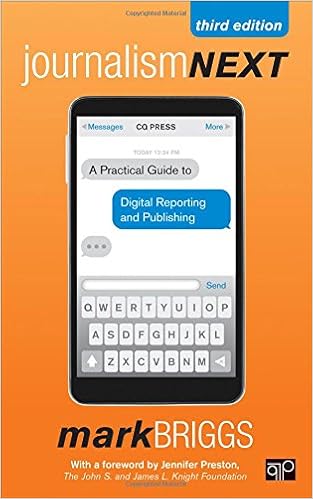
Granted, I run a company that licenses software to power social mapping for news and local shopping, so I’m bullish on the concept of collaborative publishing. My new book, Journalism Next, is filled with lessons of how the power of the crowd contributes to better journalism. While it took journalists several years to embrace Web 2.0, allowing visitors to create content, add comments and upload photos, social media has been adopted much quicker.

The painful and often arbitrary discussions in newsrooms on whether user generated content had any place next to “true” journalism certainly loosened the ground. And the motivation of a crumbling business infrastructure has played a role. But I’m still struck by how long it took journalists (years!) to recognize how powerful and flexible blogs are as a publishing platform and how quickly they flocked to Facebook and Twitter.

The new Publish2 toolset aims to help journalists “curate the real-time web,” according to a blog post by Scott Karp. This is exactly the direction news organizations should be heading in and they should be thankful that Karp and his company are helping them keep pace technologically with the HuffPos, Politicos and Techcrunches of the world. Even AOL, which now has 1,500 writers, sees opportunity in competing with (or eventually replacing?) traditional news media. (The company’s evolution from ISP to content powerhouse is a lesson many print and broadcast companies could learn from, too.)

Startup companies see opportunity in the social news space, too. SodaHead, headed by early MySpace employees, shifted its strategy from a create-your-own-quiz site to focus on creating this “social newspaper” site, though it’s hardly “first of its kind.” Apparently the PR people have never heard of Newsvine, which launched in 2006, and the many other copycat sites created since then.

Social media, social networking, social marketing and now social journalism. It’s a social world, for sure, and it seems few people are bowling alone.

It's worth noting27 Jul 2009 11:11 am

Maybe the world doesn’t need another blog focused on the digital news and content business. But that’s what it’s getting.

serramediablog1The team at Serra Media and I are working on innovative technology for local digital content companies. We want to have an outlet to share ideas and observations as we pursue new opportunities and enter (create?) new markets. So we launched a new blog recently and will be updating it frequently with product updates and lessons learned. You can find the new Serra Blog at www.serramedia.com/blog.

What that means for readers of this blog is that I will likely start posting on the hyperlocal content business and entrepreneurial approaches in the Serra Blog. (If that’s your thing, please grab the RSS feed or subscribe via email.) Meanwhile I will continue to write about using technology to do better journalism here, mixing in excerpts from my upcoming book and guest posts on occasion.

Entrepreneurial journalism23 Jul 2009 09:16 am

Editor’s Note: This is the second of two guest posts by Scott Porad, who is part of the team behind I Can Has Cheezburger? and the Cheezburger Network, the leading online destination for user-generated humor and entertainment content.

Previously I addressed the misconception that user-generated content is free. To make user-generated content work, Cheezburger expends significant cost to sift through all the user submissions to find the best quality content. However, including this expense, content costs us less to acquire and is undoubtedly of higher quality. This fundamental win-win is the promise of crowd-sourcing and user-generated content.

With that in mind, what can news journalism learn from I Can Has Cheezburger? There are probably many lessons, but one that stands out to me is a fundamental shift in the concept of reporting from “sourcing” toward “filtering.”

As an outsider, someone who never has worked as a professional news reporter, it seems that in the pre-Internet era the primary constraint on a journalist was a lack of sources with quality information. That is, in order to know what was happening somewhere, you had to know someone there who could be a source. After finding a source, a reporter would verify the quality of their information, typically by corroborating it with additional sources. In short, the name of the game was finding and developing sources.

Today, the problem is the opposite: a journalist has a million sources–anyone with e-mail, a cellphone camera, a blog or a Twitter account is a potential source. The issue now is not finding sources, but figuring out who among the myriad of them is actually providing the right information.

By way of example, let’s refer to the recent “man overboard” report on a Washington State Ferry. Within moments, Twitter was alive with real-time reports. All the news reporters had a million sources, including the US Coast Guard which was tweeting events as they happened.

But that didn’t mean they were all quality sources: yes, a report was made, helicopters were dispatched, and a search was on. But, there was no man overboard; it was a false alarm. Suddenly, the job of the news reporter changed; no longer was it “where or how can I find someone who will tell me what’s going on aboard the ferry?” Now it was: “of all these people reporting what’s happening on the ferry, who is telling the truth?”

Earlier this year I was at a panel discussion that included two leading online technology reporters: Louis Grey of louisgrey.com and Marshall Kirkpartick of ReadWriteWeb.com. Each reporter discussed the tools and techniques they used to sift through the endless volumes of sources online in order to reveal the right stories to be reporting.

I was struck as Kirkpatrick described how, at considerable and non-trivial expense, ReadWriteWeb analyzes their sources to understand which of them are the best. Like Cheezburger does with moderating images and video, ReadWriteWeb performed this analysis using a human-based process–it was not automated with computers. And, like Cheezburger, the name of the game for ReadWriteWeb is being able to effectively sift through the noise to find the signal, in a word: filtering.

And, a final example to illustrate the importance of filtering, from beyond the media world and into e-commerce: Amazon.com has relied on user-generated content since day one with their Customer Reviews. However, popular titles often have thousands of reviews submitted. For example the most recent Harry Potter book currently has 3,328 user-submitted reviews. Each of these reviews is reviewed by an Amazon employee for spam, language, appropriateness, etc.

The problem for Amazon, like Cheezburger and ReadWriteWeb, is not an issue of having enough content, but rather an issue of filtering out the best. Like Cheezburger, they have solved this problem through a combination of employee and user moderation. Leading usability expert Jared Spool estimates the solution has been worth $2.7 billion to the company.

Additionally, the reason companies invest in processes that filter for quality is because better content drives growth. Higher quality content equals positive word-of-mouth equals more traffic and users. Of course, more users leads to more submissions leads to better content. The lesson is that content publishers can’t simply publish every piece of user-generated content that is submitted, or it will diminish the quality of the product resulting in the exact opposite effect.

There is still value for news reporters and organizations to be “source leaders.” I am one who believes that there is an important role for the professional news reporter in our society. But it is clear to me that user-generated content or crowd-sourced information is a valuable addition to news journalism because it can yield more and better information, and often faster.

However, as I’ve illustrated, that information comes with a cost which is finding ways to separate the signal from the noise. The task news reporting has shifted toward filtering. My view is that winners in the Internet era of news journalism will be the people and companies who, like Cheezburger, ReadWriteWeb and Amazon, develop systematic ways of filtering the flood of user-generated content and sources down to those with the best content. The result will be higher quality news and information, that is more relevant and on target with the audience, at a lower cost.

Scott Porad is the part of the team behind I Can Has Cheezburger? and the Cheezburger Network, the leading online destination for user-generated humor and entertainment content. Scott writes about web startups, new media and miscelleany at http://scottporad.com, and you can follow him at http://twitter.com/scottporad.

Entrepreneurial journalism22 Jul 2009 08:50 am

Editor’s Note: I Can Has Cheezburger? and Failblog.org anchor the Cheezburger Network–the leading online destination for user-generated humor and entertainment content. As part of the team behind Cheezburger, I asked Scott Porad if he would share how some of their experiences might be relevant to the future of journalism. This post is the first of his two posts on that topic.

In my view, Cheezburger and news journalism are both in the media business. Although news journalism is arguably more important to society than LOLcats (arguably!), the business models are basically the same: we acquire content (either through licensing or by hiring people to create it), and then monetize that content, typically through advertising and subscriptions.

Compared to traditional humor and entertainment media companies, by relying on user-generated content to harness the wit and intelligence of our community, Cheezburger has found a way to acquire content at a lower cost. This is a significant competitive advantage for us. At the same time, thanks to the power of crowd-sourcing, the content is higher in quality and more relevant than what we could create on our own.

But there’s a catch: the important lesson from Cheezburger’s success with user-generated content is that while content costs less, it is not free. That is, even though we do not pay our users for the content they contribute, there is still a cost associated with acquiring and managing that content. Why? Because only a fraction of the content submitted to us is of high enough quality to be used.

As a result, we incur significant expense to sift and filter and sort through the submissions to find the best. Specifically, we employ a four-stage review process — two phases leverage the user community to help us filter content and two phases of review are done by moderators employed by our company.

Whether employees or users, all of our content moderation is done by humans which is not cheap. We have developed technology to streamline that process, thereby lowering the expense, but we have yet to find an effective way to automate it completely. (Truth be told, we haven’t actually tried that hard to automate it because the primary content on Cheezburger is video and images which are very expensive to machine process. Perhaps it will be worth the investment in the future.)

Regardless, even including the moderation expense, the resulting content costs us less to acquire and is undoubtedly of higher quality. This fundamental win-win is the promise of crowd-sourcing and user-generated content. By committing to the model, Cheezburger has built a profitable business, “something that few others online—not even YouTube—have been able to pull off”. [Slate, March 20, 2009]

Next: What Can News Journalism Learn from I Can Has Cheezburger?

Scott Porad is the part of the team behind I Can Has Cheezburger? and the Cheezburger Network, the leading online destination for user-generated humor and entertainment content. Scott writes about web startups, new media and miscelleany at http://scottporad.com, and you can follow him at http://twitter.com/scottporad.

Future is now21 Jul 2009 08:31 am

In May, I got all excited when David Pogue previewed a new wireless device called the MiFi from Novatel. I’ve used all manner of devices and services to connect to the Internet from wherever, and this device looked like a real step forward.

mifiTurns out I was right to get excited. I’ve been using the MiFi to work from a lake cabin in Coeur d’Alene, Idaho this week and it’s been flawless and fast. And the form factor is small and simple: just one button to turn it on and it’s small enough to fit into an Altoids tin. So you just turn it on and toss it into your laptop bag and you’ve got Internet without USB cords or cards connected to your laptop or a need for power (the battery lasts for about 3 hours).

The possibilities for news gathering and publishing are vast. (This would be perfect for sportswriters and photographers.) The MiFi will connect up to five devices to the Internet anywhere Verizon or Sprint offer coverage. That means a reporter or blogger can write and publish from pretty much anywhere. You don’t even need a power outlet.

The service isn’t cheap, of course, since the first tier of $40 per month only allows 250MB transfer. It costs $60 per month for 5GB and the device costs $100 from Verizon with a two-year contract (see plans here). But if you travel a fair amount, you could replace your home Internet with the MiFi and save on those one-time Internet connection charges at airports, hotels and Starbucks. So it’s possible you could spend less with the MiFi.

Sure beats the old days, like when I first started covering sports for a newspaper and used a Radio Shack “Trash 80″ with couplers and a pay phone to send a story from the field. The MiFi is like some kind of Jetson’s world in comparison. Now if I can only find a robot to clean my house and cook dinner.

The next book17 Jul 2009 07:53 am

(NOTE: This series of posts is an excerpt from my upcoming book, Journalism Next, which will be published by CQPress and is due out in the fall.)

As more journalists go digital, sharing information becomes easier. That’s a good thing, since most newsrooms are a river of information, much of which should be easily available to all the journalists who work there.

Recently, several of the largest news organizations have built an application provider interface (API) to allow anyone to tap into their data and build tools and Web pages. The use of APIs is nothing new in the technology world; this is how Google made its maps the basis for so many “mash-ups.” But a news organization opening up its content through the use of APIs illustrates two important developments, one technical and one political:

1. News organizations are closing the technical divide, since it takes programming skills to develop an API
2. News organizations are finally realizing that closed systems and absolute control over content don’t work in the new digital information ecosystem.

Data-driven journalism as standard practice

Opportunities abound for using databases, spreadsheets and other forms of structured or fielded data in news coverage or story development. While some situations, like writing about the census or the latest property tax valuations, are obvious, almost any assignment can be broken down into data points and organized for customized manipulation.

Think of all the information that passes through a news organization every day. Now think how little of it is accessible to those who work there, or more importantly, to interested members of the public. This problem for news organizations and journalists can be fixed by storing information electronically with spreadsheets and shared databases.

For example, a typical newsroom compiles and publishes various lists, some weekly, some annually. The first problem here is that the audience wants access to that information now, not whenever the news organization gets around to publishing it. The next problem is how much repetitive effort goes into building or updating these lists each time they are published. So most daily newspapers have launched event calendar databases on their web sites where visitors can access the most recent information anytime. And event planners can log in and add their events directly into the database.

This is just one way that many news organizations are making their Web sites “data destinations,” as well they should. Computer-assisted reporting has been around for decades, but restricted to the newspaper format, it can’t realize its full potential. On the Web, it can sing, with depth, customization, searchability and a long shelf-life. USA Today realized this years ago when it began loading the salaries of professional baseball, football, basketball and hockey players into searchable databases.

Here are some other databases news sites are building and publishing:

* Public employee salaries
* Property taxes and assessments
* Top employers
* Test scores
* Summer camps for kids
* Restaurant and movie listings
* Vital statistics (births, deaths, divorces)
* News businesses and business hires and promotions
* Guide to local ski areas, golf courses, hiking trails, etc.

Each of these types of content, and more, has been entered by newsroom staff for years, if not decades. Newspapers have found success in maximizing the value of this information by providing it to their audiences in a searchable database format while streamlining their own operation and cutting down on the amount of data entry they do.

Online databases power the personal productivity tools such as contact lists and online task lists covered in Part 2 of this series and the data-driven journalism discussed here. Once you wrap your head around the power of databases, you’ll open yourself up to a new world of possibility with regard to news and information.

Further reading:
- Data as journalism, journalism as data
- Database journalism – a different definition of ‘news’ and ‘reader,’

Previously:
- Part 1: Data-driven journalism and digitizing your life
- Part 2: Digitzing your life and getting things done

The next book16 Jul 2009 08:10 am

(NOTE: This series of posts is an excerpt from my upcoming book, Journalism Next, which will be published by CQPress and is due out in the fall.)

Unless you are a so-called “early adopter,” you probably find it impossible to keep tabs on all the latest and greatest tools and services available online. Often you get the frustrating feeling that somewhere out there exists exactly the cool new thing you need to help you with your latest task – but it just doesn’t seem worth the time and energy to try out new products from seemingly fly-by-night companies.

News flash: In most cases, the return is worth the investment. With so many tools and applications available for free (or as a free trial), the barriers to testing new applications that could save you time and help organize your life have largely been removed. And because you’re a journalist, you’re innately curious and equipped with the skills and judgment necessary to make smart decisions.

David Allen spawned a movement with his Getting Things Done book in 2002. It has grown into a cult phenomenon, with “GTD freaks” launching and publishing blogs and Web sites tailored to the millions of people who found Allen’s lessons to be a perfect fit for their helter-skelter lives.

Allen does not rely heavily on technology; a foundation for his system is to write every idea or task on a piece of paper and file it in a labeled file folder. That’s just too much paper for a digital denizen like me, but Allen’s core principles (identify, capture, organize), combined with digital technology, can help streamline your professional and personal life. Even I am willing to admit: Technology can’t do everything. But it can help.

Organize your e-mail

If you take some time to use organizational tools like filters and folders in your e-mail program, you can bring order where there is commonly chaos. But technology can do only so much. It’s kind of like driving a car: No matter how cool the car or how many gizmos it has, it’s still the driver who makes the decisions that matter.

So commit to following a few time-saving rules to manage an e-mail account (or several) that receives dozens of messages each day. The first is to limit the time your email program is up on your screen. Focus on other tasks for an hour, or two, or four, then launch e-mail again and address the new messages before closing it and getting back to your other duties. This will prevent you from being distracted by each new e-mail that arrives in your inbox and will keep you focused when you do start working with your e-mail.

One of Allen’s best GTD suggestions is to spend no more than two minutes on every e-mail. If you can reply in less than two minutes, do it. If you can’t, file it. This system works only if you’ve set up an intuitive folder system so you can move e-mails without losing track of them. Allen suggests “Waiting on” folder for storing e-mails that you can’t reply to until you receive additional information, and a “Read this” folder for storing e-mails that contain attachments or more information than can be read in two minutes. You can go back to those when you have time, or print them out and take them with you to read on a train or plane.

The goal is to look at each e-mail message only once. This will save time and thought energy.

This method is also referred to as “Inbox Zero” by Merlin Mann, who created the popular personal productivity Web site 43 Folders. The goal is have zero e-mails in your inbox after you finish an email session, much like clearing off your desk and putting everything away before you head out for lunch or home for the night.

Find the right personal productivity tools

E-mail, of course, is just the beginning. All professionals, including journalists and freelance writers, have to manage contacts, to-do lists, calendars, and notes. Depending on your profession, the list could also include spreadsheets, presentations, images, databases, project management, Web or graphic design, and collaboration with colleagues.

Fortunately, there is a bevy of slick, simple-to-use tools for doing all this – and more. The key is to find as few solutions as possible that do as many of the things on your list as possible. That way you will streamline your productivity, visiting fewer Web sites as you get things done.

Manage your time by managing your inputs. For example, if you use a system like Backpack, you can add meetings and appointments to a calendar while simultaneously managing a to-do list. It also stores any documents or images that are related to the meeting so you can keep all your stuff together. And you can access the material from anywhere, via the Web, and share it with others on your team.

An electronic system like this is better than paper because it’s easy to edit and modify lists, changing the order or priority, and also stores your calendar items and lists as an archive. Unlike paper, it can’t be lost; your system is always waiting for you online. And it is easily shared by more than one person from more than one location.

These “virtual office” solutions range from Microsoft’s Office Live Suite, which includes online versions of Word, Excel, and PowerPoint, to free online solutions like Google Docs and Zoho, which integrates with Facebook allowing to find and share your documents while Facebooking.

Storing documents and conducting all your business online is a form of cloud computing. By saving your stuff “in the cloud” (on servers accessed through the Internet) you gain the advantages of always having access to your files, no matter where you are. But, of course, you have to be able to access the Internet, an important consideration when planning your personal productivity strategy. Some online solutions feature “offline” mode, which makes the system and your files available when an Internet connection is not.

Remember to keep copies of your important files, however. This advice is worth following whether you store files in the cloud like millions of other people or store them in some system of your own. It’s been said that there are two kinds of computer users: those who back up their data, and those who will. The first time your hard drive crashes and you lose important work, you’ll know what I mean.

Further reading:
-
Lifehacker’s GTD channel
- Top 50 productivity blogs

Next: Part 3: Dawn of a new age for data driven journalism
Previously: Part 1: Data driven journalism and digitizing your life

The next book14 Jul 2009 08:05 am

(NOTE: This series of posts is an excerpt from my upcoming book, Journalism Next, which will be published by CQPress and is due out in the fall.)

Data, data everywhere. Now that we’re deep into the information age, it’s time for everyone to accept that the amount of information in our lives is only going to keep growing. As author Clay Shirky notes, “There is no such thing as information overload, only filter failure.”

This onslaught of information has a double impact on most people, and we’ll address both sides in this chapter. The first challenge is personal: taking advantage of digital tools and services to manage your day without drowning in emails, status updates, blog posts and other interesting information. The second is professional: seizing the opportunities that new technology like searchable databases, open APIs and interactive maps offer you as a journalist.

We are all Web workers now. If you use a computer for a good chunk of every day, you are constantly connected to a wealth of information and large groups of people. How do you make the most of these connections? While there are dozens of excellent sources that focus on using technology to do better journalism, it’s also incumbent on the people doing the journalism to tap into technology to improve their own productivity.

Thousands of smart people are out there working to streamline your life by creating services like Remember the Milk and Jott. Meanwhile, new technology is continually being developed to make your journalism more meaningful to your audience.

Why waste time longing for the old days, before that audience had so many claims on its attention? Better to spend the time exploring new opportunities – and you can do that by making sure you spend as little time as possible on mundane tasks like e-mail and note-taking.

So begin by digitizing your life. Then work on digitizing your journalism. This is the focus of an entire chapter in my upcoming book and I’ll publish an excerpt from each segment in the coming days.

Next: Part 2: Digitzing your life and getting things done

Random07 Jul 2009 07:23 am
Flickr photo credit: Kevin Sass

Flickr phot credit: Kevin Sass

Summer is here, my manuscript is submitted and I’m heading to Alaska for a few days of fishing with the guys. So I’m hitting the pause button on the blog and will resume later this month with more excerpts from my upcoming book and more observations on the evolution of local publishing and entrepreneurial journalism in the digital age.

Until then, keep innovating!