August 2009


Entrepreneurial journalism and Local, local, local31 Aug 2009 09:18 am

Last Friday, John Cook published a Q&A on TechFlash.com where I discussed the state of hyperlocal (and my own transition from journalist to entrepreneur). The post elicited an email from a weekly newspaper publisher who asked many probing questions. In an attempt to open up the discussion on the current and future business opportunities of hyperlocal, I asked the publisher if I could publish his comments and questions here – along with my response.

If you have ideas, questions or observations, I invite you add them in the comments.

Here is an excerpt of what I received …


Continue Reading »

Entrepreneurial journalism26 Aug 2009 08:55 am

Looking for insight on the changing business of news? Well, if you are a member of the American Society of News Editors (or know someone who is), check out the live chat tomorrow for discussion of ways to transform the news business. I’ll be joining a rock-star panel that includes Steve Outing, Dan Conover and Charlotte-Anne Lucas and am very much looking forward to their perspectives.

“Nothing could be more important for our industry now,” wrote Steve Buttry, who helped coordinate the event and who will moderate the chat. He provides further detail on his blog.

It’s tomorrow (Thursday) at 2 p.m. Eastern time. The discussion is free for ASNE members. You can register now.

The next book24 Aug 2009 08:00 am

A quick update on the book …

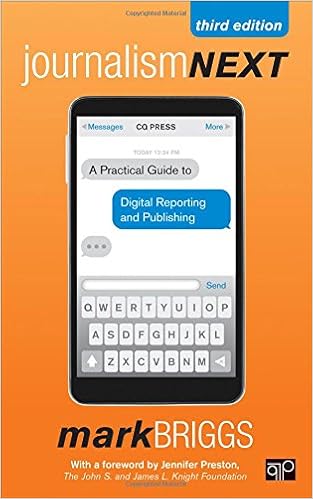
Journalism Next is set for release on Nov. 10 (just in time for the Christmas shopping season!). You can pre-order the book at CQPress’s web site for $21.95. I didn’t have a say in the price tag but I’m happy to see that it’s not one of those $50-80 textbooks that I remember loathing in college. Who needs royalties, anyway?

The cover image is set and I’m working through the final changes to the manuscript and trying to answer some last questions from editors. I’m also struggling with what to do with developments in technology since I submitted the first draft. (If you know how Facebook’s acquisition of FriendFeed or Google’s Wave will impact journalism in 2010, let me know.)

I’m also updating the professional titles for sources I interviewed. So far, four different people have changed jobs (only one lost)  since I started researching and writing in January.

What are you waiting for? Don’t you have a book to pre-order?

The next book21 Aug 2009 08:04 am

What are your must-read links for online journalism?

Thankfully, my book is nearing the finish line of production. One of the final pieces is an appendix I’m working on that will offer readers a list of blogs and Web sites that are, for me, essential reading to stay informed about online journalism.

Because the book can’t be easily updated, and technology and the ways people use it are changing every day, it’s important to give readers a way to stay informed. Help me make the list as comprehensive (but not overwhelming) as possible.

Following is a list of blogs and Web sites that I used in writing the book and frequent on a regular basis to keep in touch with what’s next in journalism. Let me know if you have a suggestion for one that I’ve missed. (Links added 8/22/09 8 a.m.)

General news about online journalism:
Journalism.co.uk
Online Journalism Review
Nieman Journalism Lab

News and commentary about the digital media revolution:
Buzz Machine
Reflections of a Newsosaur
Xark!
Recovering Journalist
E-Media Tidbits
PressThink
Contentious
Publishing 2.0
PaidContent
Mashable
MediaShift
MediaShift Idea Lab
Lost Remote
CyberJournalist
The Journalism Iconoclast
Invisible Inkling
DigiDave
Steve Yelvington
Steve Outing

New skills, concepts for journalists:

Beatblogging
Teaching Online Journalism
Innovation in College Media
Poynter Online
Journalistopia
Online Journalism Blog
Journerdism
10,000 Words
Advancing the Story
Multimedia Shooter
Interactive Narratives
The Scoop
Old Media New Tricks
CoPress

Organizations for online journalists:

Online News Association
Wired Journalists

Entrepreneurial journalism19 Aug 2009 09:00 am

Personalized news has been around for almost a decade. But building a business around the concept meant high expectations that users would take the time to build their news experience around their personal tastes.

Welcome to the era of “passive personalization” in news, courtesy of DailyMe.com, a 14-person company based in Florida led by online news pioneer Neil Budde and founded by Eduardo Hauser.

I spoke with Budde, who previously led online news efforts at Yahoo and the Wall Street Journal, last week about the breakthrough technology powering  DailyMe. Dubbed Newstogram, it tracks every view on the site and processes it to extract entities to organize by categories, topics, people, companies and organizations. So while you can personalize your news consuming experience on DailyMe.com the “old-fashioned way” by selecting your topics of interest, Newstogram improves the explicit personalization with an implicit layer based on your actual reading history.

Budde described Dailyme.com as a destination and a showcase of the technology and added that it generates some revenue from advertising. But the plan all along has been to build a combination destination news site and technology service.

Since pay walls are all the rage among publishers, the company’s timing appears perfect. Budde believes the data from Newstogram can help shape the decisions for what’s inside and what’s outside a publisher’s pay wall.

“As more sites are talking about going to a pay model, our belief is that to support that there have to be capabilities to determine what you can charge for and personalization can be part of the that,” Budde said. “We want to engage the users and help them justify the subscription.”

The Newstogram technology, which uses OpenCalais for some of its semantic processing, will be available as a free service to introduce news sites to its capability. If they want to offer personalization, publishers can choose from a variety of widgets or access the API to build something custom. Pricing will be done on a per-API call and will cost ” fractions of cents, pennies per thousand page views,” according to Budde, who also said DailyMe will offer free versions of the widgets with ads.

The company launched with a round of funding from Palladium Equity Partners last year. Budde said everything is going “very much according to plan” and that DailyMe is in position to ramp up rapidly. The company is currently in talks with a majority of the top 20 news sites and expects to make some major announcements in the near future.

Sound like fun? Budde thinks so.

“A ton of fun,” Budde said. “If we can help sustain news organizations going forward and can help them increase advertising revenue, it will be really satisfying to contribute something to the industry.”

Related:

Local Onliner: Neil Budde: Personalization, Local and Daily Me

Journalistics: DailyMe gets personal

Future is now17 Aug 2009 09:18 am

How long will colleges continue to offer journalism as a major?

I ask this question as someone with two journalism degrees, who just finished writing a journalism textbook and who as the word in his URL. But as bullish as I am on the future of journalism, I’m skeptical that traditional college journalism programs can keep pace with the requirements of the digital age. And I know I’m not the only one.

So why not make journalism a specialty of an overall communications major? This would make room for more courses on content and community management, which are the skills in demand by digital news publishers and all sorts of companies today. Shouldn’t colleges be expanding the options for their graduates instead of limiting them?


Continue Reading »

Future is now12 Aug 2009 09:13 am

Journalists prefer their craft not be cheapened with a label like “content.” But what if that’s what’s been killing the business?

Do consumers (readers) differentiate between a product called journalism than one simply known as news or content? They pay for this content with their time and attention, which is why plenty of web sites that publish content are making plenty of money with advertising. Sites that focus on journalism, however, are still struggling with this basic economic model.

Supporters of pay walls or freemium pay models for news sites are making an argument that journalism is a type of premium content that consumers will (or should) pay for. The product is expensive to produce, the thinking goes, so the consumers need to bear some of the direct cost.

I think it’s more of a failure to execute successful online advertising strategies and has less to do with the content vs. journalism debate. But one of the first arguments pay-wallers make is the importance of journalism to our democracy, suggesting this will tip the economic scale in their direction and make consumers open their wallets. (I don’t have much faith in guilt as a business model.)


Continue Reading »

Entrepreneurial journalism10 Aug 2009 10:36 am

As far as entrepreneurial opportunities go, launching a new print magazine seems a few years behind the times. Launching it from a dorm room while you’re still in college makes the odds of success even longer. Which is why I love stories like this so much.

simsLast weekend at Digital Journalism Camp Portland, I had the pleasure of meeting Bryan Sims, CEO of Brass Media, a Corvallis-based company that is in its 6th year of operation and is succeeding with an interesting and innovation revenue model.

In 2007, Businessweek named Sims to its “Best Entrepreneurs Under 25″ list. Sims’ hometown of Corvallis presented him with the 2006 “Entrepreneur of the Year” award, making him the award’s youngest recipient, at age 22.

brassSims told me he started Brass Media while a student at Oregon State, using his dorm room and his parents’ garage for an office, but dropped out to drive the business forward. He has kept his foot on the gas pedal ever since. Brass is one of the fastest growing companies in Oregon and found a place on the Inc. 500 fastest growing companies last year, too.

What’s the secret? How does a 20-something launch and grow a magazine publishing business during this period of decline for print media and an overall economic downturn?

By opening up to new ideas and expanding into new markets. A financial planning resource for young people (18-25) written by young people, Brass made its way into the classroom when a teacher in New York state requested some copies to use in a class. This led Sims to a new sales and distribution channel, and new revenue. Now the quarterly magazine circulates 350,000-400,000 copies (down from a high of 500,000) and is popular with financial institutions who want to reach this highly desirable target market.

Now Sims is diversifying again, growing a suite of multimedia and digital tools that engage his audience and build brand awareness for advertisers. He has more than two dozen employees and a national network of contributors. Leveraging that distributed resource with more digital offerings is a smart play, and one that will likely keep Brass Media on the fast track of profitable publishing .

It's worth noting07 Aug 2009 08:39 am

Want to be part of the revolution? Read on.

There’s never been a better time for innovation in journalism, digital content and community.

So come help Serra Media build interactive digital platforms for local publishers, independent journalism start-ups and university journalism programs.

My company is looking for smart people who are enthusiastic about local content, collaborative publishing and the future of digital content. We’re specifically looking for budding stars in the areas of community management, social marketing and web development (Drupal experience preferred).

If that’s you, check out the details on Serra Media’s Fall Internship Program. These aren’t traditional news/journalism positions, but will be valuable experience and a good resume builder for those digitally inclined J-students.