May 2009


Entrepreneurial journalism28 May 2009 09:50 am

(NOTE: Following is a guest post from Julia Scott, who makes a living writing the savvy-spending blog, BargainBabe.com.)

Four months ago I gave up my job as a reporter, blogger and columnist at a mid-size newspaper to launch my own personal finance blog. I knew in my gut that this career path, though uncertain, held more promise.

I prepared for longer hours and brainstormed creative ways to make ends meet. But I didn’t account for a 180-degree shift in perspective about what it means to practice journalism in the Internet age.

My new perspective came about while attending an intense, week-long training program at the Knight Digital Media Center on the campus of the University of Southern California. I was one of 15 mid-career journalists eager to soak up the business skills needed to practice our craft independent of mainstream news organizations.

One of my main tasks at the program, called News Entrepreneur Boot Camp, was to craft a 15-second elevator pitch for my business, BargainBabe.com. I revised my pitch a dozen times before realizing I was using it to recruit new readers. But really, the purpose of the pitch was to land me a paying client.

It mattered less why people should read my blog than why businesses could make money by advertising on it. This was a hard nut to swallow. Here’s my pitch:

Does your business have enough customers? For many businesses, the answer is no. BargainBabe.com connects them with people who are ready to spend.

Independent journalists (the fancy term is news entrepreneur), must think as businessmen. My readers don’t pay me so my business side dictates they are no longer my primary focus. But for the journalist inside me, typing those words is sacrilege. For years I have endured long hours for little pay in the service of readers.

I am not dismissing the needs of my readers because without them I have nothing to offer paying customers. But my new perspective means I must balance the needs of my business with my calling as a journalist. For anyone else considering working as an independent journalist, walking this line will be one of your first challenges, too.

Transparency is essential, as is a commitment to produce high-quality content that meets reader needs. A willingness to spend as many hours – or more – developing your business as you do writing is also essential. My job is still creative, but oftentimes that means using my creativity to make money, not words.

Execution is everything and The next book27 May 2009 09:19 am

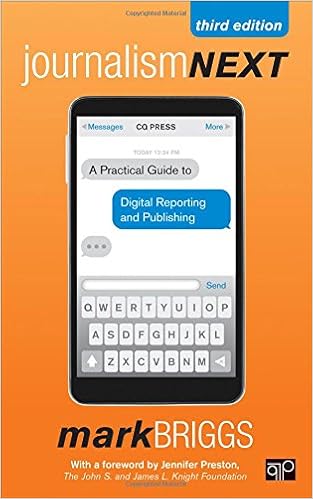
(NOTE: The following is an excerpt from my upcoming book, Journalism Next, which will be published by CQPress and is due out in the fall.)

Charles Betram was home mowing his lawn on a sunny weekend in Lexington a year ago when his assignment editor and good friend, Tom Woods, called. Woods was watching his nephew’s baseball team playing and suggested Bertram come to the park to see this remarkable kid playing on the other team.

“I was a little put-off at having to go inside and get cleaned up on my day off, but I really love baseball,” said Bertram, whose son was drafted by the Detroit Tigers and is playing in their minor league system. “So I hustled to the park.”

Adam Bender was 8 years old when Bertram showed up to his Southeastern Rookie League at Veterans Park. Having lost a leg to cancer when he was one, Adam was competing with only one leg. Bertram, a photographer at the Herald-Leader newspaper, arrived too late to shoot photographs of the game so he used the trip to meet Adam’s parents and coaches and find out when the next game would be played.

Bertram came back for the next game and shot still photographs of Adam. While the images of a one-legged boy competing with able-bodied youngsters were compelling, they didn’t tell the whole story.

“After looking at the shoot, it was fairly obvious that I needed video to show his incredible ability to ‘run’ the bases,” Beteram said.

So Bertram returned with a video camera and captured the action of Adam hopping to first base after a hit. He receives arm braces at first base, then rounds the rest of the bases quickly. From his catcher position, Adam blocks the plate but lets an opponent score on one play. Then comes back on the next and records the out.

Hopefully, you have already seen the two-and-a-half minute video. If not, you should. It has no voiceovers. It has no titles. No interviews. No description of the setting, no context for the story. The images, the action, the emotion are so compelling the viewer is moved with inspiration. It’s a powerful story of the human spirit that could be told best in video. No other form would do as much.

“I realized after one game of shooting that the only difference between Adam and his teammates was that he had only one leg,” Bertram said. “His attitude was that of a baseball player — not a ‘handicapped’ baseball player. That’s when I decided to shoot the video with no voiceovers and no interviews. I wanted the video to stand strictly on his athletic ability and without any additional attention drawn to his assumed handicap.”

Published on June 1, 2008, the video went viral. At the time, the most popular video on the Herald-Leader Web site would receive 500 views. Bertram’s video of Adam has now been seen nearly 3 million times, about half coming from the Herald-Leader site, the rest from embedded video players on YouTube and other sites, include Lance Armstrong’s Livestrong.org site.

“I had several comments from photographers who appreciated my approach to telling Adam’s story,” Bertram said. “In fact, I heard that after the story ran in the paper, that several of his teammates were a little upset and wondered what was so special about Adam, that they were baseball players too. I think I was prouder of that comment than anything else relating to the entire story. I knew then that I had accomplished a story on the human spirit and not just a story on a kid with a handicap.”

Since the story was published in the Lexington Herald-Leader, and on www.kentucky.com, Adam has been invited to throw out first pitches at home games for the Chicago White Sox, Cincinnati Reds, Houston Astros, and has been invited to a Garth Brooks benefit in Las Vegas. He was also profiled in a 10-minute story on ESPN and appeared on CBS, ABC and NBC and even in People magazine.

It’s a great lesson for journalists: be faithful to the story, no matter the medium.

Entrepreneurial journalism and Future is now26 May 2009 10:42 am

A key role for journalism in the digital age is to provide intelligence to data. That emerged as a common theme running through each of the projects developed Friday at GonzoCamp in Seattle. Now that we are swimming in more data than ever, journalists need to develop technology to help them provide intelligence for that data.

- Who owns the company that published a news story?
- What other stories have been reported about this topic?
- What other news occurred in this location?

Those are questions a news organization typically wouldn’t venture to answer. But the independent thinking that powered the first GonzoCamp tackled those questions with a short window for development. I’m impressed by what was accomplished and excited to discuss future GonzoCamp events in other locations to see what else can be built.

We started with some simple questions: What can journalists learn from computer programmers and software developers? And can the programmers and developers learn anything from the journalists?

We also added experienced entrepreneurs and students into the mix and ended up with a surprisingly cohesive group. Based on informal responses from the participants, several important lessons were learned.

“I think it worked great and I would come again,” said Brianne Pruitt, web editor for the Wenatchee World newspaper. “If you work for a news organization, sometime it takes a long time to get anything done. So it was cool to come together today and make so much progress in such a short time.”


Continue Reading »

It's worth noting22 May 2009 11:07 am
Hanson Hosein welcomes attendees to GonzoCamp

Hanson Hosein welcomes attendees to GonzoCamp

GonzoCamp is in full swing at the University of Washington in Seattle. Three teams are working on different ideas that were picked from more than a dozen suggestions pitched during the morning session. Now the race is on as groups of programmers, journalists, developers and business development folks try to put build a prototype of the tool or technology.

Follow the progress on Twitter: #gonzocamp.

gonzocamp2

Entrepreneurial journalism and Future is now21 May 2009 09:20 am

In case you’ve been living under a rock for the past year, you’ve encountered this persistent conversation about the future of news and journalism in a digital world. A Senate sub-committee spent three hours on it recently and most cities in the U.S. have had their share of panel discussions and one-day workshops focused on the topic.

While discussions and presentations serve a purpose, some folks are ready for more action and less words.

Enter GonzoCamp, a one-day event in Seattle tomorrow, that will bring together tech-savvy journalists, programmers, designer/developer/UI people, entrepreneurs and college students. Using a barcamp-style unconference, the goal is to pitch ideas and work in teams to build a functioning prototype of a new digital destination or platform in one day.

Will it work? Will we end the day with something functional and useful? It’s a longshot, but I guarantee the event will be worthwhile to all 35 people who registered.

The event mostly “sold out” in two days (it’s free, but space was limited to the size of the room), meaning there is plenty of interest in moving this discussion from PowerPoint presentations to a sort of code sprint.

The idea first came up for me in a conversation with John Cook and Cory Bergman a few months ago following an ONA panel discussion. (Cook blogged about it here.) As I asked around Seattle I discovered several other people were thinking about such an event, too. (Fortunately, those folks will be at GonzoCamp tomorrow.)

So I convinced my company, Serra Media, to co-sponsor the event. Then the University of Washington’s Masters of Communication in Digital Media program joined as a co-sponsor and is providing us a great room at the UW.

So we’ll see how it turns out. There are no guarantees, of course, but there are some amazingly smart and talented people on the registration list. So even if we aren’t able to produce something tangible in a day (actually about half a day of actual work time), I have no doubt everyone will benefit from working with other people from different backgrounds with different talents.

Discover, play and learn. It’s how innovation is born. And tomorrow we’ll see if a new event called GonzoCamp can produce it with lots of smart people working with a limited amount of time.

(Note: You can follow along by using the #gonzocamp hashtag.)

It's worth noting20 May 2009 08:49 am

David Pogue from the New York Times shows off a seemingly “killer app” for mobile journalism with a recent feature on personal hotspots, including the the Novatel MiFi and Cradlepoint devices. The MiFi is like having a wifi router in your pocket, Pogue reports, meaning a reporter or blogger could be online from anywhere at speeds that are faster than the USB modems that have become standard equipment for many journalists.

Verizon and Sprint will apparently be marketing the MiFi and hoping the speeds are fast enough for consumers to consider replacing their home internet service with the device (if you don’t have a big house, since the range is only about 30 feet).

News organizations would be wise to give these a try. If it works as well as advertised, it could make the USB 3G cards and Clearwire service look like a dial-up modem from the 1990s. Until, that is, the 4G and WiMax networks come online next year.

Future is now15 May 2009 02:08 pm

If you were just starting out in journalism and were given the chance to turn back the clock to the 1970s, a golden era for newspapers, would you do it?

About half of the young journalists I spoke with yesterday would. The discussion was a kick-off to a full week at the Freedom Forum in Nashville for the new crop of Chips Quinn scholars.

A quick post on Twitter with this anecdote brought some interesting reactions:

@johnhcook That’s depressing. They really want to go back in time to journalism in the 70s. No thanks.

@joemichaud Seen that myself. Sad. Plus, I’ve been to the ’70s and this is better.

@osazuwa don’t journos feel excited? despite challenges to biz model, its never been easier to gather, create, share, and have impact

I spent the next two hours trying to persuade them that now is still a great time to be in journalism, even if the job listings have dried up. I also relayed the state of the job market in 1991 when I started my career.

Not able to even get a part-time job answering the phones on Friday and Saturday nights in the sports dept. of a small daily, I found a gig writing high school sports summaries for a weekly newspaper out somewhere in cow country. To pay the rent, I also found a job waiting tables and helped a friend remodel a house for his mom. Glamorous, huh?

That was in 1991, another recession and pre-internet, when there was no way to get published unless you worked for someone with a printing press. Now, of course, you don’t have to wait until someone hires you to start publishing digitally. You can take control of your own destiny and start learning the digital world (see @copress, @alanataylor, @digidave, etc.) so you have skills and experience to land the gig you want when the job market turns around. (Five years after I got out of school grads were getting signing bonuses!)

You can’t control the timing on when to launch your career, but you have more control over your destiny than any generation before you. Use it.

Entrepreneurial journalism12 May 2009 08:35 am

UCLA MBAI don’t know when or where I first heard the term entrepreneurial journalism, but I know it wasn’t that long ago. The business model for journalism had gone pretty much unchanged for decades in printed newspapers and magazines, with some new slices of the pie carved out for radio, then television and then cable.

But the Internet changed everything, of course, by dismantling the distribution models that supported great journalism for a long time. A quote I like is that “Pulitzers never made newspapers great businesses. Local distribution monopolies made newspapers great businesses.”

Now those monopolies are gone, so what are we going to do? How will government be held accountable for spending taxpayer money if newspapers go away? How will local news get covered?

On Friday I had the honor of moderating a lively discussion on the business of journalism in the digital age at UCLA. The audience consisted of entrepreneurs and MBA students and, as Dan Gaines from the LA Times noted before the session, it was somewhat surprising and gratifying that such a venue would set aside time for the topic of journalism.

Joining Gaines and myself were David Cohn of Spot.Us, LA Times investigative reporter Bill Heisell (who resigned his position that same day to take a position with the Gates Foundation), and Zach Behrens from LAist. As I told the audience of 60-70 when we started, we have an hour to accomplish what a Senate subcommittee couldn’t do in three hours the day before.

Actually, our mission wasn’t to “solve” the economic problems facing journalism today, but to engage with business-minded folks in a discussion of the business problems and opportunities. We know that a combination of disruption by the Internet, plus a bad economy, plus some poor decision-making by traditional and mainstream news organizations has led to this crisis, but talking about how we got in this hole isn’t constructive. So we looked at some examples and kicked around some ideas to try to get a glimpse of where all this might be going.

One thing for sure, at least to me, is that it will take an entrepreneurial mindset to successfully make the transition to the digital age. So it was fascinating to hear entrepreneurs ask questions and offer ideas. One in particular I had not heard before or considered: On the topic of bloggers without editors vs. news organizations with infrastructure and processes for quality assurance of investigative journalism, someone from the audience suggested a media house like the LA Times should become a service provider. He suggested that if a blog could gain a larger audience by having a “stamp of approval” from a reputable news organization on its content, whomever is running that blog might pay for such a service and endorsement.

Cohn and I, who have been involved in a number of these discussions, looked at each and half-jokingly said: “Alright, problem solved!”

Continue Reading »

Entrepreneurial journalism07 May 2009 01:24 pm

Just posted on the Serra Media site:

There’s never been a better time for innovation in journalism, digital content and community. If that’s your thing and you need a gig this summer, we want to hear from you.

Serra Media is looking for some fresh perspectives and top-notch talent to boost our mission. You will help us build interactive digital platforms that local publishers, independent journalism start-ups and university journalism programs use as part of our new internship program.

But we’re taking a different approach to finding interns. Instead of a
specific, rigid framework of duties, tasks, hours and pay that you try
to ply yourself into, we’re inviting you to make a pitch on the
assignment as if you were an entrepreneur. (Because you are.)

These are paid positions, but the amount we pay and the number of hours you work per week are flexible. So, instead of applications for a set position and fixed number of hours, we’re looking for pitches from people who are interested in working with us to develop our ideas and see their own brought to market, no matter their situation.

If all this sounds unconventional and unlike anything you’ve ever applied to before, that’s OK. Welcome to the new world of entrepreneurial journalism. The bottom line is:

  • There are amazing young journalists, programmers and Web developers out there.
  • Serra Media is developing ground-breaking tools and technology for local news and community Web sites
  • We think it would be great if some of this new talent could contribute to Serra Media’s projects.

You can earn course credit for the assignment, if needed. You can also work remotely if you don’t happen to live in the Seattle area. (Why waste money on relocation costs?) But the top three benefits of scoring a Serra Media internship are:

  1. You will learn a lot about the new media landscape
  2. You will do work that matters
  3. Your efforts will produce demonstrable results for local new Web sites that you can brag about in your next job interview.

To apply, send us an email pitch of 300-500 words with links to your
blog or examples of your work and tell us which type of position you
are most interested in. Your choices:

Community cultivator: Grow a meaningful, constructive community of Web users through outreach, participation and creativity.

Programming wiz: Develop software-as-a-service that helps local news Web sites innovate, grow traffic, increase interactivity and make more money.

Your pitch must also include the following:

  • Date you can start
  • Number of weeks you can serve (ideally between 6-12)
  • Number of hours per week you want to work
  • Amount of pay you need per week to make it interesting

Send email to: ideas@serramedia.com. Deadline: May 22, 2009.

It's worth noting and Local, local, local06 May 2009 01:44 pm

The Detroit Plan is “cutting edge, innovative and based on technology,” according to Paul Anger, who is Vice President, Publisher and Editor of the Detroit Free Press.

While cutting back home delivery to three days a week may sound more “cutting” than “cutting edge,” the plan is showing impressive results. And Anger’s presentation was among the highlights of the 20th annual Interactive Media Conference today in New Orleans.

Side note about the conference: attendance is down 27%, from 304 to 233. Some newspaper companies have had sharper declines in revenue, so all things being relative, that’s not too bad. (It’s easier to meet people and network in a smaller conference, but the sessions feel a little flat when the rooms are half empty.)

The basic business formula of “The Detroit Plan” is to use the remaining three days of home-delivered revenue, growing online revenue, expense savings based on four less days of home delivery and a fully staffed newsroom. The savings on home delivery are huge: Anger said Detroit newspaper’s trucks distributing the Free Press and Detroit News drove the equivalent of “to the moon and back” in a week’s time.

Anger also said the plan is the “good news in Detroit” in a year that the auto industry is crumbling, the mayor was ousted and the Lions went winless.

The results from 6 weeks: 3.5% of print subscribers canceled, 30,000 read the e-Editions online, 7,000 receive a print copy same-day through the mail, and traffic on detnews.com and freep.com has increased.

Anger said the company really had no choice but to make a dramatic change to its operations. The economy in Detroit is so bad and the average age of a print subscriber is 60. Not pretty.

He reported positive feedback from both readers and advertisers (while admitting it’s still very early) and announced plans to lease e-readers by the end of the year. The devices are being developed by Plastic Logic.

However the Detroit Plan ultimately fares, the company’s swift and dramatic action to take control of its future is both impressive and admirable. In Detroit, at least, the future really is now.

Next Page »