Azerbaijan has had the world’s fastest growing economy for the past five years. That growth hasn’t extended to the media sector, however, as the spread of news remains limited to a few pro-government newspapers and some underground anti-government publications.
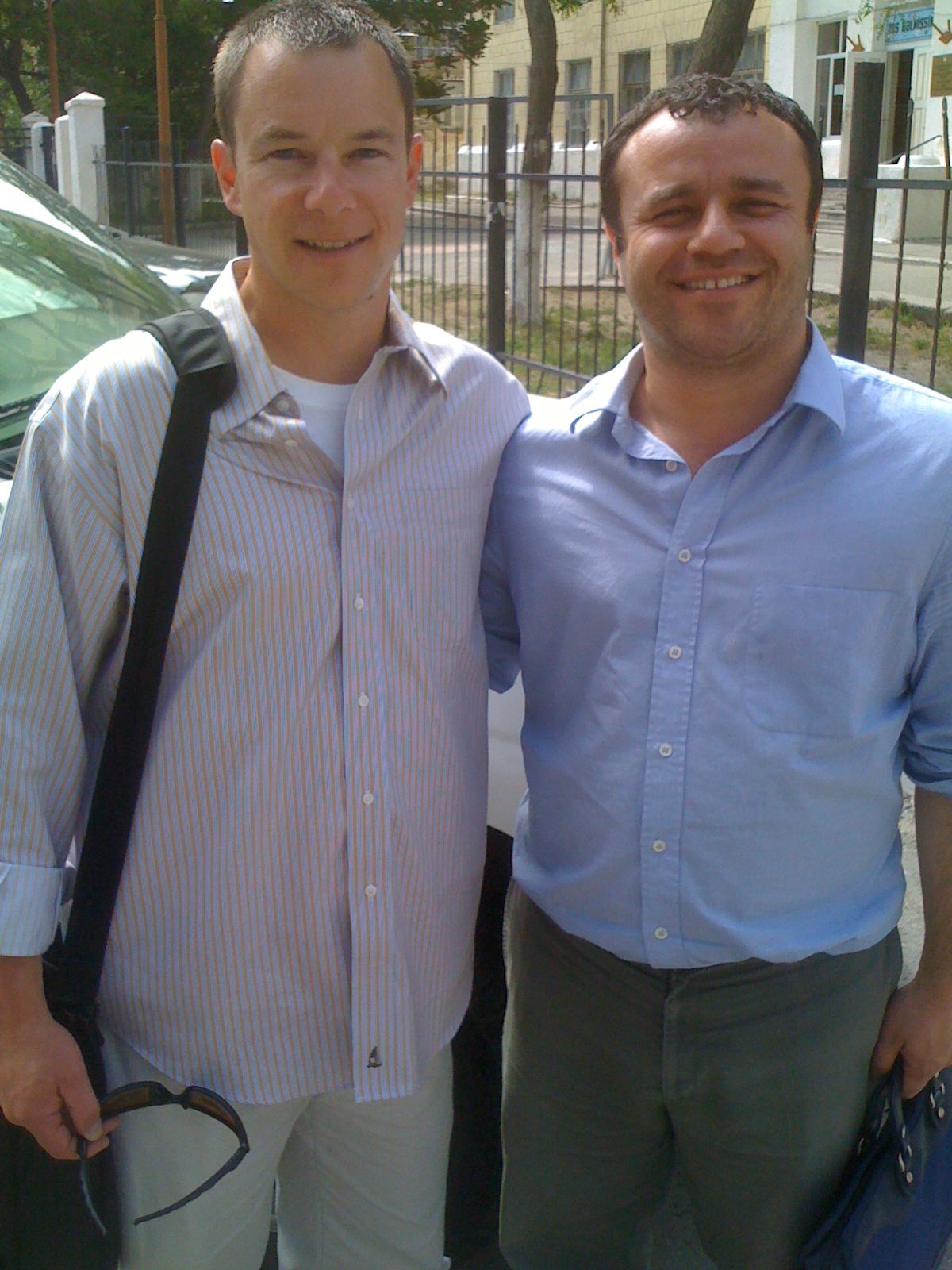
During my four days in Baku, the nation’s capital city, I met with dozens of journalists. Some had jobs at newspapers or TV stations, some were writing on their own and many were just starting out as students. But they all had the same passion for journalism that brought you and I to this profession. (Rashad Shirin, right, served as my interpreter for four days in Baku, making it possible for me to discuss journalism with Azeri journalists.)
In Azerbaijan, however, there are far more hurdles to clear. News outlets must receive a special license from the government, which means there is no investigative reporting. (The government doesn’t tolerate criticism.) Independent news sources, mostly online, apparently operate with a single-minded focus on complaining about the government, so the idea of journalistic objectivity and fairness are a “work in progress,” to put it mildly.
Still, many journalists I spoke to are hopeful that the Internet will change the game and bring a diversity of voices and reporting to a nation that sorely needs it. Unfortunately, this nation also sorely needs affordable Internet access and smartphone availability if it is to emulate the thriving new media ecosystem of other countries.
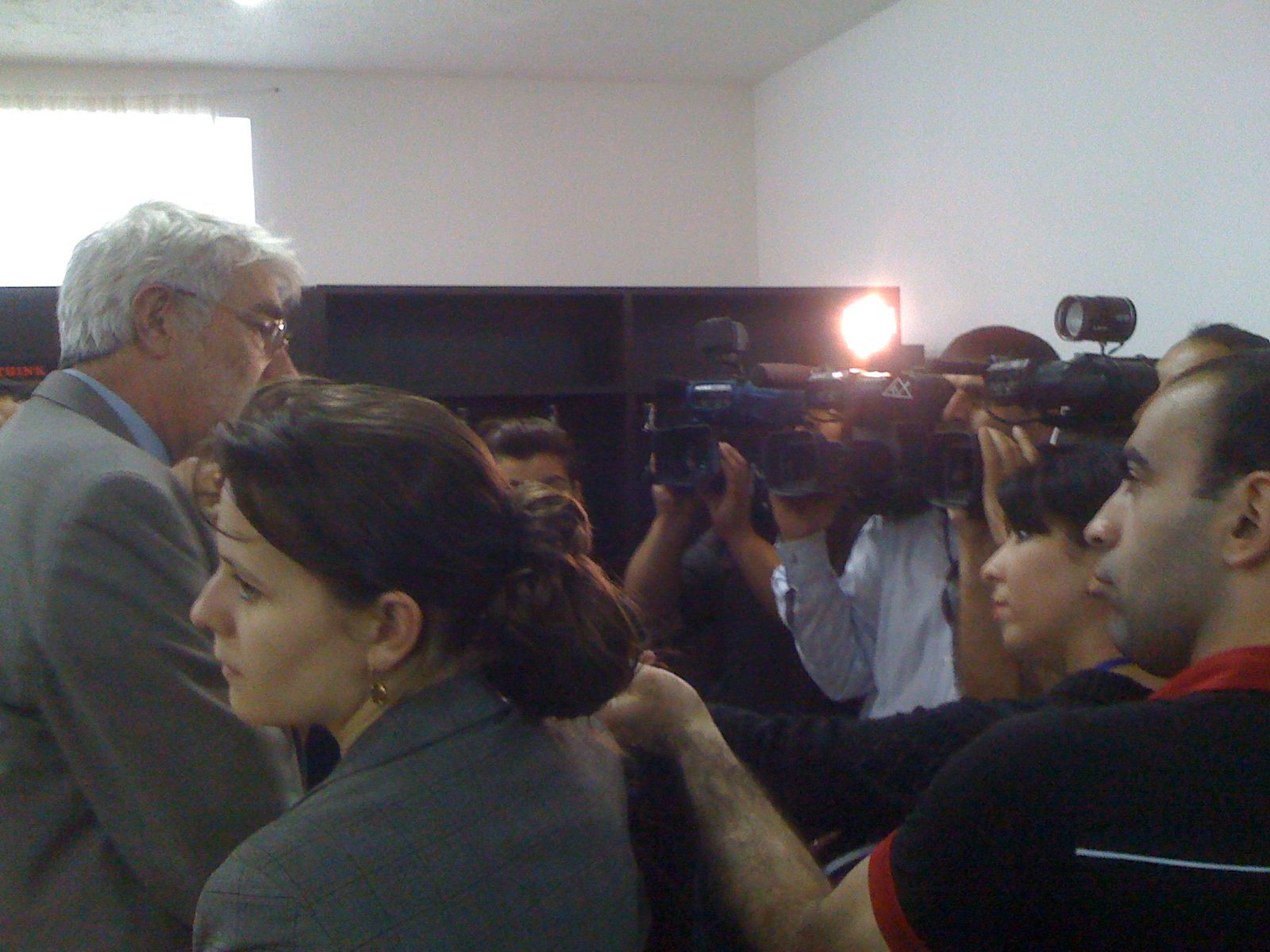
Terry Davidson, public information officer of the U.S. Embassy in Baku, answers questions from reporters about the translation of Journalism 2.0.
There certainly is a lot of interest in journalism for a place that has such struggles with it. At the event where the translated version of Journalism 2.0 was introduced, three TV cameras and a handful of newspaper reporters surrounded me and the public information officer for the U.S. Embassy, Terry Davidson, to ask questions. (Can’t say I’ve received that kind of interest from journalists in the U.S.)
A group of journalists-turned-community coordinators that I met with had recently returned from the U.S. They met with journalists in Washington, D.C. and Dallas, where they met with my friend Mike Orren. The founder of Pegasus News, one of the most successful local independent journalism startups, Orren has survived the entrepreneurial roller coaster for more than five years. Meeting with Azeri journalists gave him a new perspective.
“I came away humbled at how much we take our freedoms for granted,” Orren wrote on his blog. “I’ve bitched and moaned over the years about how hard it was/is to do a start-up. But I can’t imagine how different that would be in a world where I had to fear for every word I typed.”
(You should have seen the Azeris’ faces light up when, while demonstrating Twitter, I showed them a DM from Orren about his meeting with them with the conclusion: “Amazing people.”)
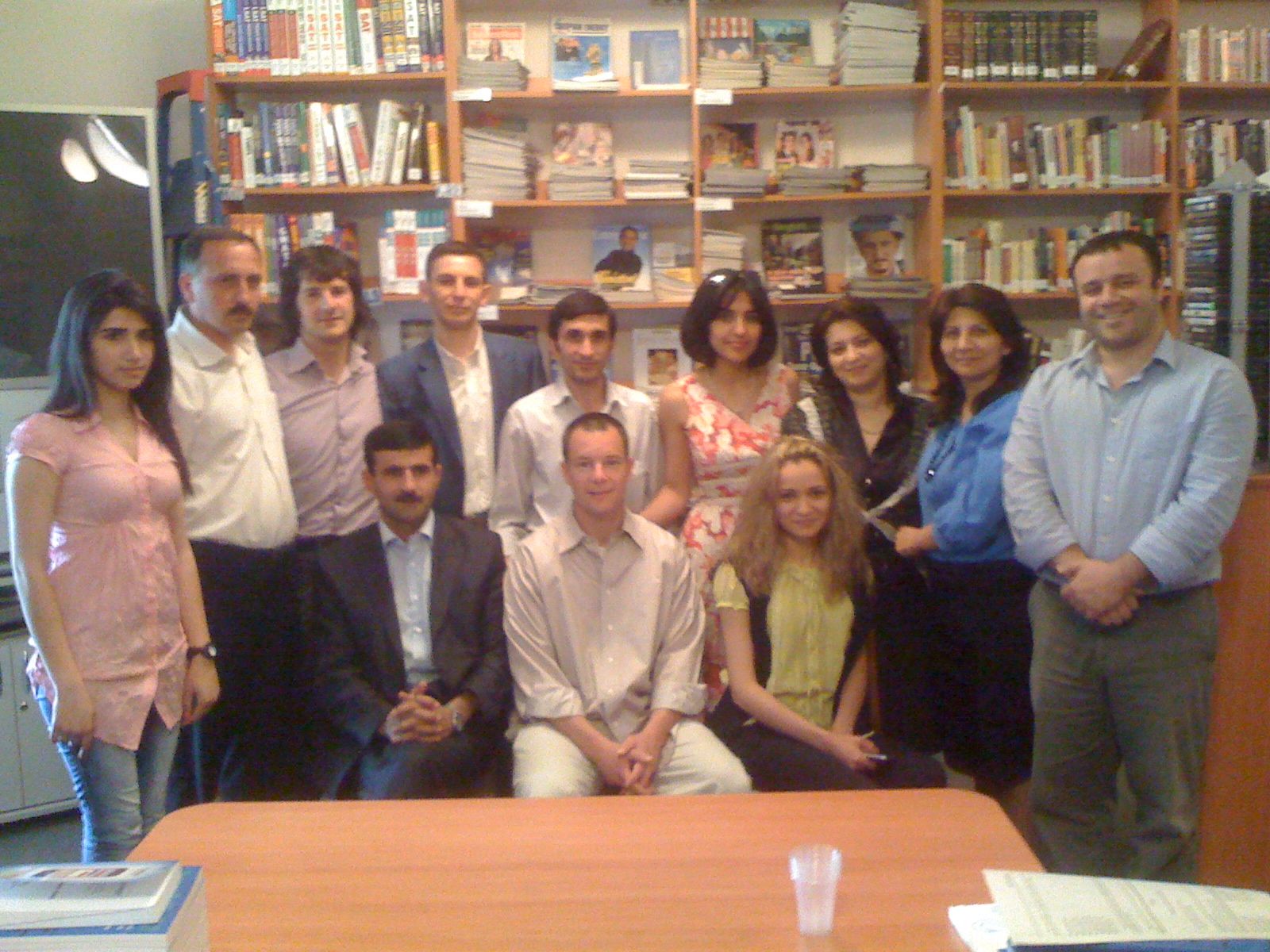
Journalists / community coordinators after our training session at the American Center in Baku.
I agree. I was impressed by the fortitude of those blogging and using social media to spread independent ideas and challenge the status quo (even more impressive when so many of their friends and colleagues had been jailed for similar activities.) And I recognized the optimism of the student journos because it looked just like the idealism and intelligence I frequently see on college campuses in the U.S. While the U.S. students think they are facing adversity – and they are – the Azeri students are facing more yet seemed resolute in their commitment to journalism.
When I asked one group why they are interested in journalism, one young man replied with a somewhat sheepish grin: “To be famous.” Indeed, that’s how many journalists in the U.S. got started. Seeing that byline, hearing your voice on the air or seeing yourself on screen can be a powerful motivator. But this reply came from a student who lives in a country where some of the most well-known journalists are famous for being jailed.
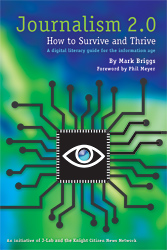
That courage, combined with the tools of new media, will hopefully bring about a new era of journalism in this emerging country. If my book helps this process along even just a little, I’ll be proud to consider myself part of the Azeri journalism evolution.
 Mark Briggs
  Posted in
  Tags:
Tags: 



I just want to tell you that I’m all new to blogging and actually savored you’re website. Almost certainly I’m planning to bookmark your blog . You absolutely have perfect posts. Thanks a lot for sharing with us your blog site.
Hi there! Do you know if they make any plugins to safeguard against hackers? I’m kinda paranoid about losing everything I’ve worked hard on. Any recommendations?
Hi, I just ran across your weblog via Bing. Your viewpoint is truly pertinent to my life right now, and I’m really pleased I discovered your website.
[url=https://finasteridealop.com/]finasteride buy online[/url] [url=https://metforminglc.com/]metformin er 500[/url] [url=https://plavix.us.com/]plavix buy[/url] [url=https://prozac.us.com/]buy prozac[/url] [url=https://disulfiram.us.com/]where can you buy antabuse[/url]
Hi, I do think this is a great site. I stumbledupon it 😉 I’m going to revisit once again since i have book marked it. Money and freedom is the greatest way to change, may you be rich and continue to guide other people.
I’ve observed that in the world these days, video games include the latest trend with children of all ages. Often times it may be extremely hard to drag young kids away from the video games. If you want the very best of both worlds, there are many educational activities for kids. Great post.
Your style is unique in comparison to other people I have read stuff from. Thanks for posting when you’ve got the opportunity, Guess I will just bookmark this site.
Howdy! This blog post could not be written any better! Going through this article reminds me of my previous roommate! He always kept talking about this. I will forward this information to him. Pretty sure he’ll have a very good read. I appreciate you for sharing!
Good post. I learn something totally new and challenging on blogs I stumbleupon every day. It’s always exciting to read articles from other writers and use something from other websites.
I really like looking through a post that can make men and women think. Also, thank you for allowing me to comment.
Way cool! Some very valid points! I appreciate you writing this write-up plus the rest of the site is really good.
MetroClick specializes in building completely interactive products like Photo Booth for rental or sale, Touch Screen Kiosks, Large Touch Screen Displays , Monitors, Digital Signages and experiences. With our own hardware production facility and in-house software development teams, we are able to achieve the highest level of customization and versatility for Photo Booths, Touch Screen Kiosks, Touch Screen Monitors and Digital Signage. Visit MetroClick in NYC at http://www.metroclick.com/ or , 121 Varick St, New York, NY 10013, +1 646-843-0888.
Varick Street Litho , VSL Print is one of the top printing company in NYC to provide the best Digital Printing, Offset Printing and Large Format Printing in New York. Their printing services in NYC adopts state of the art digital printing services and offset digital printing for products postcards, business cards, catalogs, brochures, stickers, flyers, large format posters, banners and more for business in NYC. For more information on their digital printing nyc, visit http://www.vslprint.com/ or http://www.vslprint.com/printing at 121 Varick St, New York, NY 10013, US. Or contact +1 646 843 0800